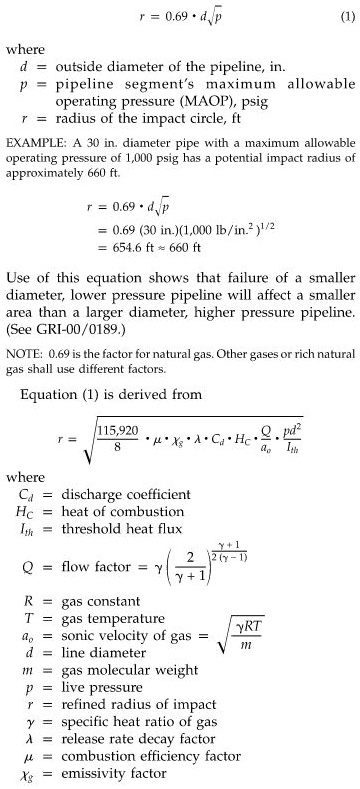
r= 0.69 \cdot d\sqrt{p} (1)
where
d = outside diameter of the pipeline, in.
p = pipeline segment's maximum allowable operating pressure (MAOP), psig
r = radius of the impact circle, ft
EXAMPLE: A 30 in. diameter pipe with a maximum allowable operating pressure of 1,000 psig has a potential impact radius of approximately 660 ft.
r = 0.69 \cdot d\sqrt{p}
= 0.69 (30 in.)(1,000 lb/in.$^2$)$^{1/2}$
= 654.6 ft \approx 660 ft
Use of this equation shows that failure of a smaller diameter, lower pressure pipeline will affect a smaller area than a larger diameter, higher pressure pipeline. (See GRI-00/0189.)
NOTE: 0.69 is the factor for natural gas. Other gases or rich natural gas shall use different factors.
Equation (1) is derived from
r = \sqrt{\frac{115,920}{8} \cdot \mu \cdot \chi_g \cdot \lambda \cdot C_d \cdot H_c \cdot \frac{Q}{a_o} \cdot \frac{pd^2}{I_{th}}}
where
C_d = discharge coefficient
H_c = heat of combustion
I_{th} = threshold heat flux
Q = flow factor = \gamma \left(\frac{2}{\gamma + 1}\right)^{\frac{\gamma + 1}{2(\gamma - 1)}}
R = gas constant
T = gas temperature
a_o = sonic velocity of gas = \sqrt{\frac{\gamma RT}{m}}
d = line diameter
m = gas molecular weight
p = live pressure
r = refined radius of impact
\gamma = specific heat ratio of gas
\lambda = release rate decay factor
\mu = combustion efficiency factor
\chi_g = emissivity factor