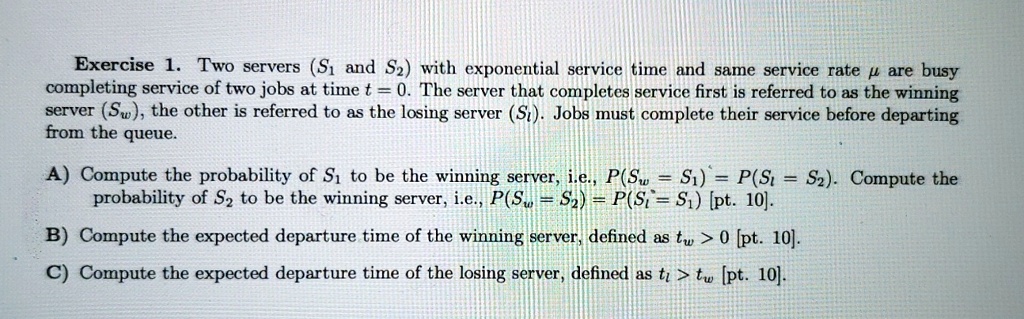
Exercise 1. Two servers and {(:S_(2))} with exponential service time and same service rate mu are busy completing service of two jobs at time t=0. The server that completes service first is referred to as the winning server (S_(w)), the other is referred to as the losing server (S_(l)). Jobs must complete their service before departing from the queue.
A) Compute the probability of S_(1) to be the winning server, i.e., P(S_(w)=S_(1))^(')=P(S_(l)=S_(2)). Compute the probability of S_(2) to be the winning server, i.e., P(S_(w)=S_(2))=P(S_(l)^(**)=S_(1)) [pt. 10].
B) Compute the expected departure time of the winning server, defined as t_(w)>0 [pt. 10].
C) Compute the expected departure time of the losing server, defined as t_(l)>t_(w) [pt. 10].
Exercise 1. Two servers (S and S2with exponential service time and same service rate are busy completing service of two jobs at time t=0.The server that completes service first is referred to as the winning server (Sw), the other is referred to as the losing server (St). Jobs must complete their service before departing from the queue.
A Compute the probability of S to be the winning serveri.e.P(Sw= Si= PSi=S.Compute the probability of Sto be the winning server,i.e.PSS=PS=S)[pt.10] B Compute the expected departure time of the winning serverdefined as tw> 0 [pt.10]
C) Compute the expected departure time of the losing server,defined as ti> tw [pt. 10]