Question 1
2 pts
1. You are a fly geneticist and notice two different fly mutants in your bottle of
otherwise wildtype flies. One mutant fly is uncoordinated (u), where coordinated is the
wildtype phenotype (u+). The other mutant fly has oval wings (o), where curved wings
is the wildtype phenotype (o?). You propagate each of the flies to obtain true breeding
lines. You then cross an oval-winged, coordinated female fly to a curved-wing,
uncoordinated male fly. You find that all the F1 are phenotypically wildtype, all have
curved wings and are coordinated.
As a good geneticist, you perform the reciprocal cross (curved-wing, uncoordinated
female x oval wing, coordinated male \textendash{} assume true breeding) and in the F1 obtain
curved-wing, coordinated females and curved-wing, uncoordinated males.
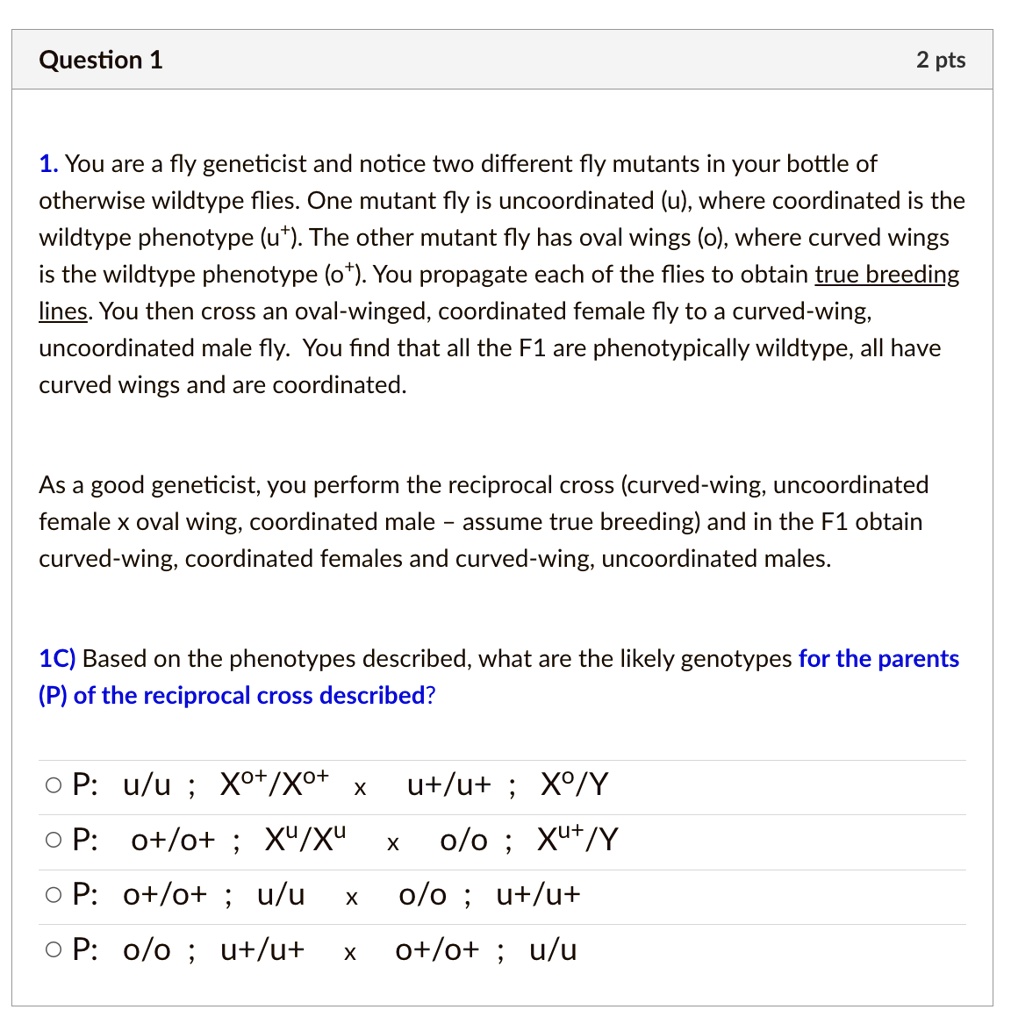
1C) Based on the phenotypes described, what are the likely genotypes for the parents
(P) of the reciprocal cross described?
?P: u/u ; $X^{o+}/X^{o+}$ x u+/u+ ; $X^{o}/Y$
?P: o+/o+ ; $X^{u}/X^{u}$ x o/o ; $X^{u+}/Y$
?P: o+/o+ ; u/u x o/o ; u+/u+
?P: o/o ; u+/u+ x o+/o+ ; u/u