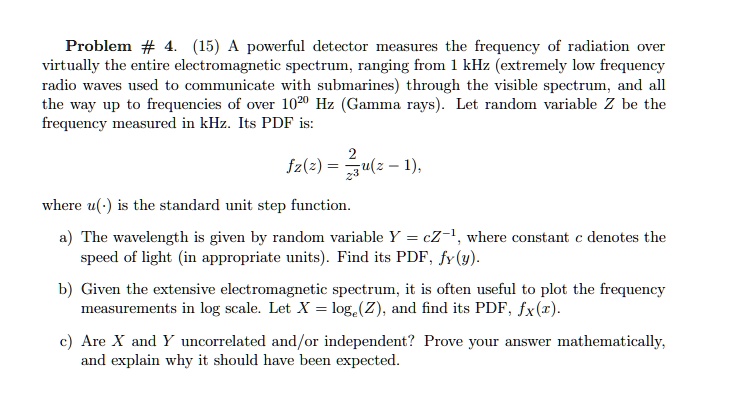
Problem # 4. (15) A powerful detector measures the frequency of radiation over virtually the entire electromagnetic spectrum, ranging from 1 kHz (extremely low frequency radio waves used to communicate with submarines) through the visible spectrum, and all the way up to frequencies of over $10^{20}$ Hz (Gamma rays). Let random variable Z be the frequency measured in kHz. Its PDF is:
$\frac{2}{z^3}u(z - 1)$,
where $u(.)$ is the standard unit step function.
a) The wavelength is given by random variable Y = $cZ^{-1}$, where constant c denotes the speed of light (in appropriate units). Find its PDF, $f_Y(y)$.
b) Given the extensive electromagnetic spectrum, it is often useful to plot the frequency measurements in log scale. Let X = $log_e(Z)$, and find its PDF, $f_X(x)$.
c) Are X and Y uncorrelated and/or independent? Prove your answer mathematically, and explain why it should have been expected.