Text: Described how one salesperson entered into a contract company that ended up not being advantageous. How could the seller have learned more about the culture of the buying firm before negotiating and entering into that contract?
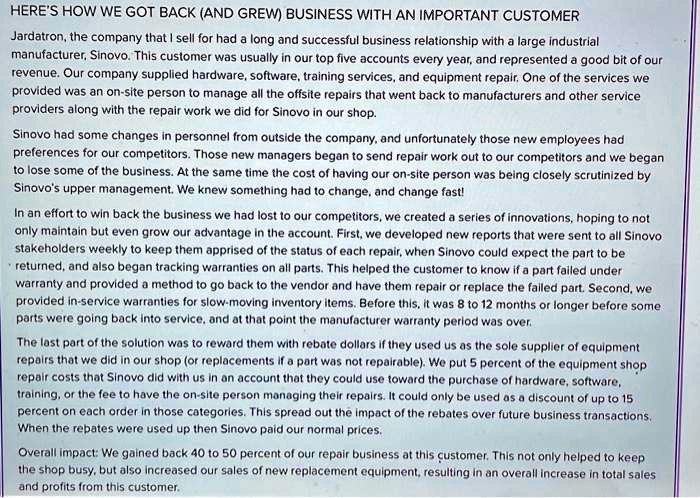
HERE'S HOW WE GOT BACK (AND GREW) BUSINESS WITH AN IMPORTANT CUSTOMER
Jardatron, the company that I sell for, had a long and successful business relationship with a large industrial manufacturer, Sinovo. This customer was usually in our top five accounts every year and represented a good bit of our revenue. Our company supplied hardware, software, training services, and equipment repair. One of the services we provided was an on-site person to manage all the offsite repairs that went back to manufacturers and other service providers along with the repair work we did for Sinovo in our shop.
Sinovo had some changes in personnel from outside the company, and unfortunately, those new employees had to lose some of the business. At the same time, the cost of having our on-site person was being closely scrutinized by Sinovo's upper management. We knew something had to change, and change fast!
In an effort to win back the business we had lost to our competitors, we created a series of innovations, hoping to not only maintain but even grow our advantage in the account. First, we developed new reports that were sent to all Sinovo stakeholders weekly to keep them apprised of the status of each repair, when Sinovo could expect the part to be returned, and also began tracking warranties on all parts. This helped the customer to know if a part failed under warranty and provided a method to go back to the vendor and have them repair or replace the failed part.
Second, we provided in-service warranties for slow-moving inventory items. Before this, it was 8 to 12 months or longer before some parts were going back into service, and at that point, the manufacturer warranty period was over.
The last part of the solution was to reward them with rebate dollars if they used us as the sole supplier of equipment repairs that we did in our shop (or replacements if a part was not repairable). We put 5 percent of the equipment shop repair costs that Sinovo did with us in an account that they could use toward the purchase of hardware, software training, or the fee to have the on-site person managing their repairs. It could only be used as a discount of up to 15 percent on each order in those categories. This spread out the impact of the rebates over future business transactions. When the rebates were used up, then Sinovo paid our normal prices.
Overall impact: We gained back 40 to 50 percent of our repair business at this customer. This not only helped to keep and profits from this customer.