Ace - AI Tutor
Ask Our Educators
Textbooks
My Library
Flashcards
Scribe - AI Notes
Notes & Exams
Download App
luz camacho

luz c.

Divider

Questions asked

BEST MATCH

A mortgage applicant who expects interest rates to rise would be MOST interested in a. a mortgage lock-in. b. a due-on-sales clause. c. a settlement statement. d. refinancing a mortgage.

View Answer
divider
BEST MATCH

On January 1 of the current year, the Rawley Ritchie Company purchased office machinery for $150,000. The office machinery has an estimated useful life of 5 years and an estimated salvage value of $15,000. Complete the depreciation schedule below. Each formula in column D must include the DDB function. Cost $150,000 Salvage $15,000 Life (in years) 5 January 1 book value Depreciation Expense Accumulated Depreciation December 31 book value Year 1 2 3 4 5

View Answer
divider
BEST MATCH

The diagram below has two solutions of differing concentrations separated by a semipermeable membrane. Identify the concentrations given the flow of particles indicated by the diagram. A 0.0412 M Solution A Solution B B 0.411 M C

View Answer
divider
BEST MATCH

Find the length of the following curve. $y = \frac{x^2}{8} - \ln x$, $2 \le x \le 12$ The length of the curve is $oxed{}$ (Type an exact answer.)

View Answer
divider
BEST MATCH

According to agency theory, what is the role of the auditor? You should explain what agency theory says about the role of the auditor and why agency theory is relevant to the auditor-client relationship.

View Answer
divider
BEST MATCH

The 5.386 estimated coefficient on A means that Question 3Select one: a. one dollar spent on advertising is associated with an increase in sales of about $5.386. b. one dollar spent on advertising will increase sales by 1,387.3 + 5.386, or $1,392.686. c. spending $5.386 on advertising will generate an extra dollar of sales.

View Answer
divider
BEST MATCH

2. Explain with the aid of a flow-chart or diagram the basic unit operations in solid catalyst preparation. 3. One half-cell is made up with 1.50 M potassium dichromate and 0.30 M chromium(III)nitrate hexahydrate in 1.00 M nitric acid and the other half cell is made up with 0.050 M iron(III) chloride hexahydrate and 0.10 M iron(II) chloride tetrahydrate. Calculate the cell potential. 4. Potassium dichromate ($K_2Cr_2O_7$) reacts with Fe(II) to produce Cr(III) and Fe(III). What is the standard state potential, $E^0$ and equilibrium constant, K for this reaction.

View Answer
divider
BEST MATCH

obtain the general solution to the second order equation \(t^2x'' = x'(3t - x)\)

View Answer
divider
BEST MATCH

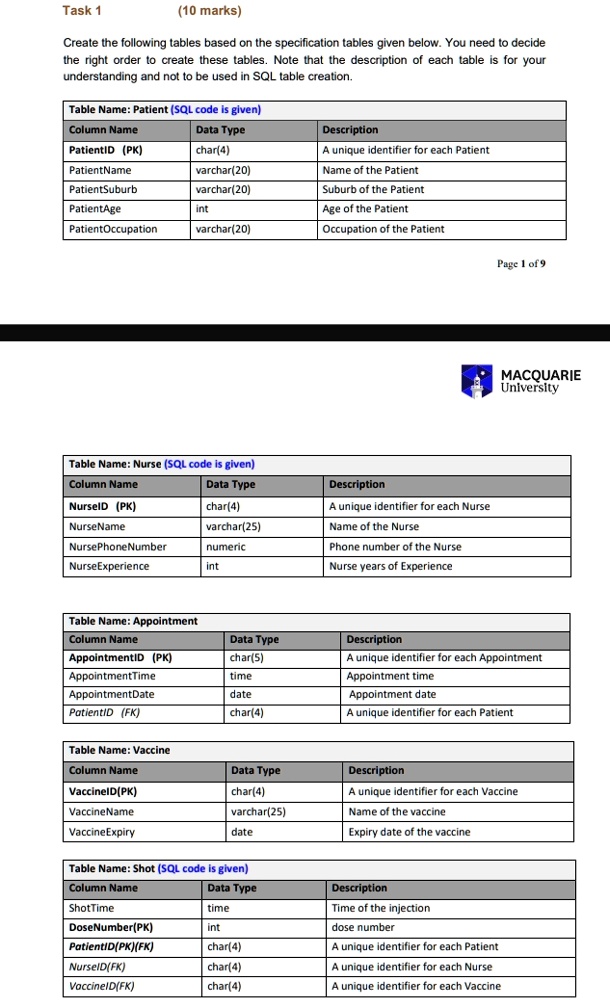
Texts: Instruction: 1. Write the SQL statements/queries for the tasks provided below. 2. Some SQL statements (for creating some tables/populating some tables) are provided in the separate text file attached with this specification document. Run the statements to get the created and populated tables. Task 1: Create the following tables based on the specification tables given below. You need to decide the right order to create these tables. Note that the description of each table is for your understanding and not to be used in SQL table creation. Create table Patient ( PatientID char(4), PatientName varchar(20), PatientSuburb varchar(20), PatientAge int, PatientOccupation varchar(20), constraint Patient_PK primary key (PatientID) ); Create table Nurse ( NurseID char(4), NurseName varchar(25), NursePhoneNumber numeric, NurseExperience int, constraint Nurse_PK primary key (NurseID) ); Create table Appointment ( AppointmentID char(5), AppointmentTime time, AppointmentDate date, PatientID char(4), constraint Appointment_PK primary key (AppointmentID), constraint Appointment_FK foreign key (PatientID) references Patient (PatientID) ); Create table Vaccine ( VaccineID char(4), VaccineName varchar(25), VaccineExpiry date, constraint Vaccine_PK primary key (VaccineID) ); Create table Shot ( ShotTime time, DoseNumber int, PatientID char(4), NurseID char(4), VaccineID char(4), constraint Shot_PK primary key (DoseNumber, PatientID), constraint Shot_FK1 foreign key (PatientID) references Patient (PatientID), constraint Shot_FK2 foreign key (NurseID) references Nurse (NurseID), constraint Shot_FK3 foreign key (VaccineID) references Vaccine (VaccineID) ); Insert into Patient values('P001','RICKY PONTING','BURWOOD',46,'HEALTH'); Insert into Patient(PatientID, PatientName, PatientSuburb, PatientAge, PatientOccupation) values('P002','MATHEW HYDEN','BURWOOD',48,'EDUCATION'), ('P003','BRIAN LARA','MARSFIELD',52,'EDUCATION'), ('P004','YOUNAS KHAN','EPPING',45,'AGED CARE'), ('P005','RAHULL DRAVID','TOP RYDE',49,'HOSPITALITY'), ('P006','KANE WILLIAMSON','AUBURN',39,'HEALTH'), ('P007','BRIAN LARA','LIVERPOOL',55,'EDUCATION'), ('P008','EOIN MORGAN','EPPING',37,'AGED CARE'), ('P009','KUMAR SANGAKARA','PENRITH',42,'HOSPITALITY'), ('P010','ANDY FLOWER','EPPING',61,'HEALTH'); Insert into Vaccine(VaccineID, VaccineName, VaccineExpiry) values ('V001','PFIZER','2021-11-01'), ('V002','MODERNA','2022-01-01'), ('V003','SPUTNICK','2022-03-01'), ('V004','SINOVAC','2022-01-01'), ('V005','PAKVAC','2022-12-01'); Insert into Shot(ShotTime, DoseNumber, PatientID, NurseID, VaccineID) values ('11:00',1,'P001','N001','V001'), ('12:00',1,'P003','N002','V002'), ('11:30',1,'P002','N003','V003'), ('13:00',1,'P004','N002','V001'), ('14:15',1,'P008','N001','V004'), ('12:00',2,'P003','N005','V002'), ('10:00',2,'P001','N001','V001'), ('15:00',2,'P008','N001','V004'), ('16:00',2,'P004','N005','V001'), ('12:30',1,'P007','N006','V005'), ('11:00',1,'P006','N006','V004'), ('10:30',1,'P005','N004','V005'); Task 1 (10 marks): Create the following tables based on the specification tables given below. You need to decide the right order to create these tables. Note that the description of each table is for your understanding and not to be used in SQL table creation. Table Name: Patient (SQL code is given) Column Name Data Type PatientID (PK) char(4) PatientName varchar(20) PatientSuburb varchar(20) PatientAge int PatientOccupation varchar(20) Description: A unique identifier for each Patient Name of the Patient Suburb of the Patient Age of the Patient Occupation of the Patient Table Name: Nurse (SQL code is given) Column Name Data Type NurseID (PK) char(4) NurseName varchar(25) NursePhoneNumber numeric NurseExperience int Description: A unique identifier for each Nurse Name of the Nurse Phone number of the Nurse Nurse years of Experience Table Name: Appointment Column Name Data Type AppointmentID (PK) char(5) AppointmentTime time AppointmentDate date PatientID (FK) char(4) Description: A unique identifier for each Appointment Appointment time Appointment date A unique identifier for each Patient Table Name: Vaccine Column Name Data Type VaccineID (PK) char(4) VaccineName varchar(25) VaccineExpiry date Description: A unique identifier for each Vaccine Name of the vaccine Expiry date of the vaccine Table Name: Shot (SQL code is given) Column Name Data Type ShotTime time DoseNumber (PK) int PatientID (PK)(FK) char(4) NurseID (FK) char(4) VaccineID (FK) char(4) Description: Time of the injection Dose number A unique identifier for each Patient A unique identifier for each Nurse A unique identifier for each Vaccine
View Answer
divider
BEST MATCH

Title: Bank Reconciliation of Dunlap Insurance at December 31, 2018 Follow (Click the icon to view the checkbook.) Dunlap's Cash account shows a balance of $16,910 at December 31. On December 31, Dunlap Insurance received the following bank statement (Click the icon to view the December bank statement.) Data Table X Requirement 1: Prepare the bank reconciliation of Dunlap Insurance at December 31. Prepare the bank portion of the reconciliation, followed by the book portion of the reconciliation. Dunlap Insurance Cash Receipts Cash Payments Bank Reconciliation Date Cash Debit Check No. Cash Credit December 31, 2018 Dec. 4 $4,220 1416 880 Bank: 480 1417 220 14 520 1418 730 ADD: 17 2,350 1419 1,190 31 1,790 1420 1,510 LESS 1421 1,100 1422 620 (Click the icon to view the additional information.) Read the comments More info Data Table X The EFT credit was a receipt of rent. The EFT debit was an insurance payment. The NSF check was received from a customer. The $1,300 bank collection was for a note receivable. The correct amount of check no.1419, for rent expense, is $1,910. Dunlap's controller mistakenly recorded the check for $1,190. Bank Statement for December Beginning Balance Deposits and other Credits Dec. EFT $200 Dec. 4,220 Dec. 10 $480 Dec. 15 $520 Dec. 18 $2,350 Dec. 22 BC $1,300 Checks and other Debits: Dec. 8 NSF $1,000 Dec. 11 (check no. 1416) $880 Dec. 19 EFT $840 Dec. 22 (check no. 1417) $220 Dec. 29 (check no. 1418) $730 Dec. 31 (check no. 1419) $1,910 Dec. 31 $40 Ending Balance $13,800 Print Done $9,070 Print Done Books: ADD: Requirements ($5,620) $17,250 LESS 1. Prepare the bank reconciliation of Dunlap Insurance at December 31, 2018. Journalize any required entries from the bank reconciliation Explanations: BC - bank collection; EFT - electronic funds transfer; NSF - nonsufficient funds checks; SC - service charge Print Done Choose from any list or enter any number in the input fields and then continue Print Done

View Answer
divider