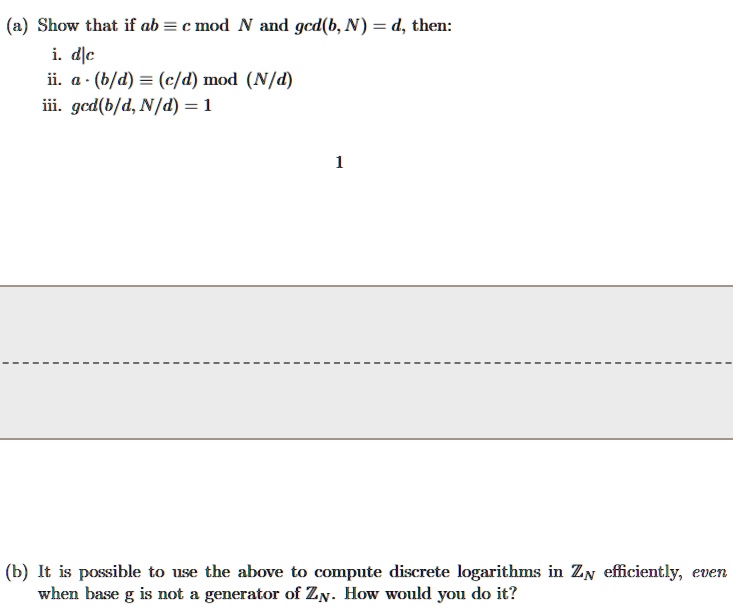
(a) Show that if ab \equiv c \mod N and gcd(b, N) = d, then:
i. $d | c$
ii. a \cdot (b/d) \equiv (c/d) \mod (N/d)
iii. gcd(b/d, N/d) = 1
(b) It is possible to use the above to compute discrete logarithms in $Z_N$ efficiently, even
when base g is not a generator of $Z_N$. How would you do it?