Your answer is partially correct.
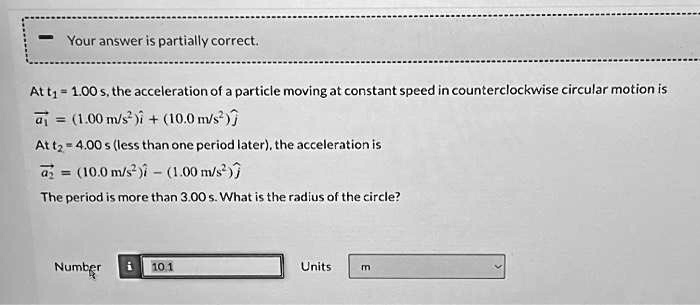
At $t_1 = 1.00$ s, the acceleration of a particle moving at constant speed in counterclockwise circular motion is
$\vec{a_1} = (1.00 \text{ m/s}^2)\hat{i} + (10.0 \text{ m/s}^2)\hat{j}$
At $t_2 = 4.00$ s (less than one period later), the acceleration is
$\vec{a_2} = (10.0 \text{ m/s}^2)\hat{i} - (1.00 \text{ m/s}^2)\hat{j}$
The period is more than 3.00 s. What is the radius of the circle?