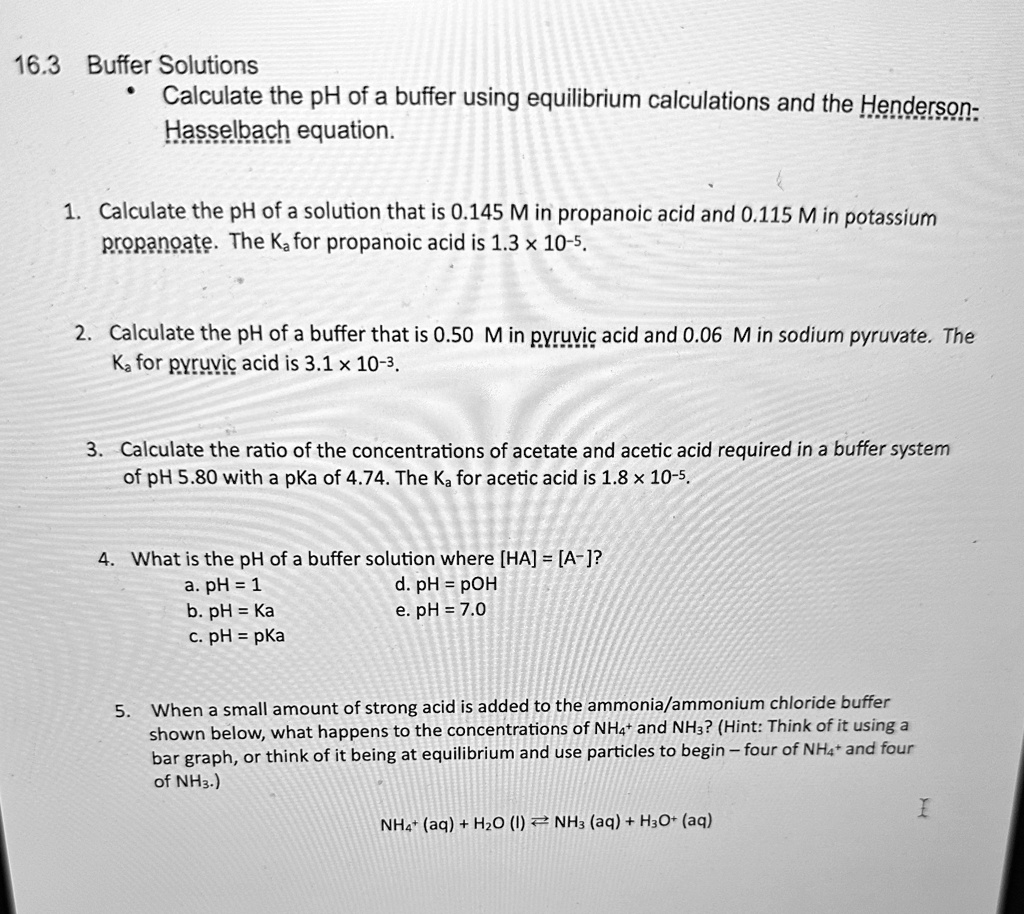
16.3 Buffer Solutions
Calculate the pH of a buffer using equilibrium calculations and the Henderson-Hasselbach equation.
Calculate the pH of a solution that is 0.145 M in propanoic acid and 0.115 M in potassium propanoate. The Ka for propanoic acid is 1.3 x 10^(-5).
Calculate the pH of a buffer that is 0.50 M in pyruvic acid and 0.06 M in sodium pyruvate. The Ka for pyruvic acid is 3.1 x 10^(-3).
Calculate the ratio of the concentrations of acetate and acetic acid required in a buffer system of pH 5.80 with a pKa of 4.74. The Ka for acetic acid is 1.8 x 10^(-5).
What is the pH of a buffer solution where [HA]=[A-]?
a. pH=1
d. pH=pOH
b. pH=Ka
e. pH=7.0
c. pH=pKa
When a small amount of strong acid is added to the ammonia/ammonium chloride buffer shown below, what happens to the concentrations of NH4+ and NH3? (Hint: Think of it using a bar graph, or think of it being at equilibrium and use particles to begin - four of NH4+ and four of NH3.)
NH4+(aq) + H2O(l) ⇄ NH3(aq) + H3O+(aq)