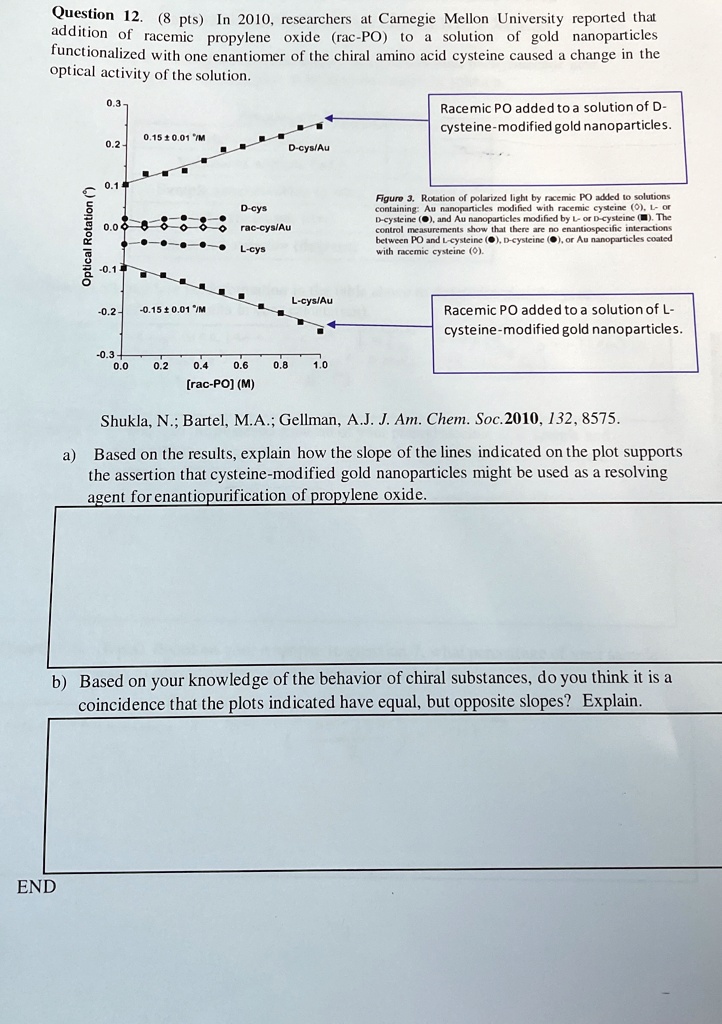
Question 12. (8 pts) In 2010, researchers at Carnegie Mellon University reported that
addition of racemic propylene oxide (rac-PO) to a solution of gold nanoparticles
functionalized with one enantiomer of the chiral amino acid cysteine caused a change in the
optical activity of the solution.
0.3-
0.15±0.01°/M
0.2
D-cys/Au
Racemic PO added to a solution of D-
cysteine-modified gold nanoparticles.
Optical Rotation (°)
0.1
-0.1
-0.2-
-0.15 ± 0.01 /M
D-cys
rac-cys/Au
L-cys
L-cys/Au
Au
L-or
Figure 3. Rotation of polarized light by racemic PO added to solutions
containing:
nanoparticles modified d with racemic cysteine (0),
D-cysteine (), and Au nanoparticles modified by L or D-cysteine (). The
control measurements show that there are no enantiospecific interactions
between PO and L-cysteine (), D-cysteine (), or Au nanoparticles coated
with racemic cysteine (0).
Racemic PO added to a solution of L-
cysteine-modified gold nanoparticles.
-0.3+
0.0 0.2 0.4 0.6 0.8 1.0
[rac-PO] (M)
Shukla, N.; Bartel, M.A.; Gellman, A.J. J. Am. Chem. Soc. 2010, 132, 8575.
a) Based on the results, explain how the slope of the lines indicated on the plot supports
the assertion that cysteine-modified gold nanoparticles might be used as a resolving
agent for enantiopurification of propylene oxide.
b) Based on your knowledge of the behavior of chiral substances, do you think it is a
coincidence that the plots indicated have equal, but opposite slopes? Explain.
END