Ace - AI Tutor
Ask Our Educators
Textbooks
My Library
Flashcards
Scribe - AI Notes
Notes & Exams
Download App
m-nica crane

m-nica c.

Divider

Questions asked

BEST MATCH

3) Şekildeki devrede; a) $I_C$ akımını b) $V_o/V_s$ gerilim kazancını c) alt kesim frekansını hesaplayınız $V_{cc} = 20 V$ $V_{cc} = 20 V$, $\beta = 100$, $R_1 = 40 k\Omega$, $R_2 = 10 k\Omega$, $R_C = 4 k\Omega$, $R_E = 2 k\Omega$, $R_S = 2.2 k\Omega$, $R_L = 1 k\Omega$, $C_S = 10 \mu F$, $C_C = 1 \mu F$ ve $C_E = 20 \mu F$

View Answer
divider
BEST MATCH

Question 12 Score on last try: 1 of 2 pts. See Details for more. You use a triple beam balance to weigh an object in air (see figure 1) and then in a fluid of density $\rho_r$ (see figure 2). The scale reads $m_{dry}g$ when the object is weighed in air and $0.60m_{dry}$ when weighed in the fluid. You may neglect the buoyant force due to the air in the following questions. O need more information $m_{dry}g$ $m_{dry}g$-BF, where BF is the buoyant force c.) State Archimedes' principle and draw a free-body diagram on the object in Figures 1 and 2. Sum the forces on the object in figures 1 and 2 and apply Archimedes' principle to derive the equation for the density of the object. Express your results in terms of the given quantities. You should ask yourself, "What is the value of the difference in the tensions in figures 1 and 2?" You should express the scale reading as $nm_{dry}$ (where n is between zero and one) in your solution. This will allow you answer part (d.) more efficiently. $\rho_o$= $\rho_r$ d.) What function represents the density of the object. Express your function in terms of n (see part c). $\rho_o$= $\rho_r$ a.) What is the value of the tension in the string in figure 1? $m_{dry}g$ zero $m_{dry}g$-BF, where BF is the buoyant force need more information b.) What is the value of the tension in the string in figure 2? zero

View Answer
divider
BEST MATCH

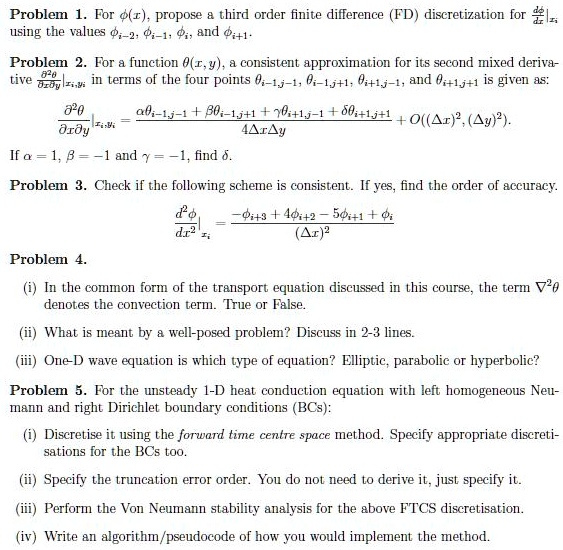
Problem 1. For $\phi(x)$, propose a third order finite difference (FD) discretization for $\frac{d^2 \phi}{dx^2}|_i$ using the values $\phi_{i-2}$, $\phi_{i-1}$, $\phi_i$, and $\phi_{i+1}$. Problem 2. For a function $\phi(x, y)$, a consistent approximation for its second mixed derivative $\frac{\partial^2 \phi}{\partial x \partial y}|_{i,j}$ in terms of the four points $\phi_{i-1,j-1}$, $\phi_{i-1,j+1}$, $\phi_{i+1,j-1}$, and $\phi_{i+1,j+1}$ is given as: $$\frac{\partial^2 \phi}{\partial x \partial y}|_{i,j} = \frac{\alpha \phi_{i-1,j-1} + \beta \phi_{i-1,j+1} + \gamma \phi_{i+1,j-1} + \delta \phi_{i+1,j+1} + O((\Delta x)^2, (\Delta y)^2)}{4 \Delta x \Delta y}.$$ If $\alpha = 1$, $\beta = -1$ and $\gamma = -1$, find $\delta$. Problem 3. Check if the following scheme is consistent. If yes, find the order of accuracy. $$\frac{d^2 \phi}{dx^2}|_i = \frac{-\phi_{i+3} + 4 \phi_{i+2} - 5 \phi_{i+1} + \phi_i}{(\Delta x)^2}$$ Problem 4. (i) In the common form of the transport equation discussed in this course, the term $\nabla^2 \theta$ denotes the convection term. True or False. (ii) What is meant by a well-posed problem? Discuss in 2-3 lines. (iii) One-D wave equation is which type of equation? Elliptic, parabolic or hyperbolic? Problem 5. For the unsteady 1-D heat conduction equation with left homogeneous Neumann and right Dirichlet boundary conditions (BCs): (i) Discretise it using the forward time centre space method. Specify appropriate discretisations for the BCs too. (ii) Specify the truncation error order. You do not need to derive it, just specify it. (iii) Perform the Von Neumann stability analysis for the above FTCS discretisation. (iv) Write an algorithm/pseudocode of how you would implement the method.
View Answer
divider
BEST MATCH

4. Integrate $\int_0^1 \int_0^1 xe^y dy dx$.

View Answer
divider
BEST MATCH

Problem 5. Find the linearization of $f(x, y, z) = z\sqrt{x + y}$ centered at $(8, 4, 5)$.\nProblem 6. Let $g$ be a function given by the formula $g(x, y) = e^{-2x}cos(Ay)$.\n(a) Compute all the second order partial derivatives of $g$.\n(b) Find all values of A (if any) for which $g$ satisfies the equation\n$\frac{\partial^2 g}{\partial x^2} + \frac{\partial^2 g}{\partial y^2} = 0$,\nwhich is called the Laplace's Equation.

View Answer
divider
BEST MATCH

Question 17 Not yet answered Marked out of 1 Flag question Given matrix A, $\begin{pmatrix} 1 & 2 \ 3 & 4 \end{pmatrix}$ Find $2A - 2 = ?$ Hint: 2x2 Identity matrix $I$ which is similar 1 in ordinary multiplication such as $3 \cdot 1 = 3$ $I = \begin{pmatrix} 1 & 0 \ 0 & 1 \end{pmatrix}$ a. $\begin{pmatrix} 0 & 4 \ 6 & 9 \end{pmatrix}$ b. $\begin{pmatrix} 0 & 4 \ 6 & -6 \end{pmatrix}$ c. $\begin{pmatrix} 0 & -4 \ 6 & 6 \end{pmatrix}$ d. $\begin{pmatrix} 0 & 4 \ 6 & 6 \end{pmatrix}$ e. $\begin{pmatrix} 0 & 4 \ -6 & 6 \end{pmatrix}$

View Answer
divider
BEST MATCH

A nurse is preparing to infuse RBCs at 90 mL/hr to a client profusely bleeding. The drop factor of the manual IV tubing is 20 gtt/mL. Calculate the gtt/min flow rate.

View Answer
divider
BEST MATCH

3. (5 points) Suppose that you come to the following tableau using Bland's pivot rules. Circle the correct next pivot entry according to Bland's pivot rules. Explain your choice. $x_1$ $x_2$ $x_3$ $x_4$ $x_5$ $x_6$ $x_7$ $-z$ 3 7 0 0 0 0 -1 -4 $x_2$ 2 2 1 0 0 0 3 4 $x_4$ 6 6 0 0 1 0 9 5 $x_3$ 2 3 0 1 0 0 2 3 $x_5$ 4 3 0 0 0 1 4 8

View Answer
divider
BEST MATCH

Each force is labeled with three subscripts in this order: the type of force, the object on which the force acts, and the object exerting the force. The coefficients of friction between all surfaces are μ = 0.5. Complete the missing information: a sketch, a description, and missing forces on the free-body diagram. Graphically construct the net force in the grid on the right. G = Gravity N = Normal Force f = Friction T = Tension H = Hand 1,2 = Box1, Box2 R = Rope/String E = Earth S = Surface Description: Sketch Free-Body Diagram F and a Vectors m = 2.0 kg F.S FA

View Answer
divider
BEST MATCH

Question 11 Not yet answered Marked out of 1.50 Flag question A sample has a mean of 13 and the standard of devotion 2, find the value that has a z score equal 5 Select one: a. 25 b. 20 c. 2 d. 23

View Answer
divider