Questions asked
Damage to which part of the cerebral cortex would cause a patient to be unable to speak? Temporal lobe Broca area Parietal lobe Wernicke area Confident Not Sure
Effector 1) Cephalic Phase Function: Main Stimuli: 1) Signal 2) 3) Control Center Parasympathetic NS (PSNS) Effector Result: Catorcenter 2) Gastric Phase Function: Trigger: Result: Bolus Stic 3) Harmonie Centre Center Boomerang Secres wi ames Hormone. Tags Result:
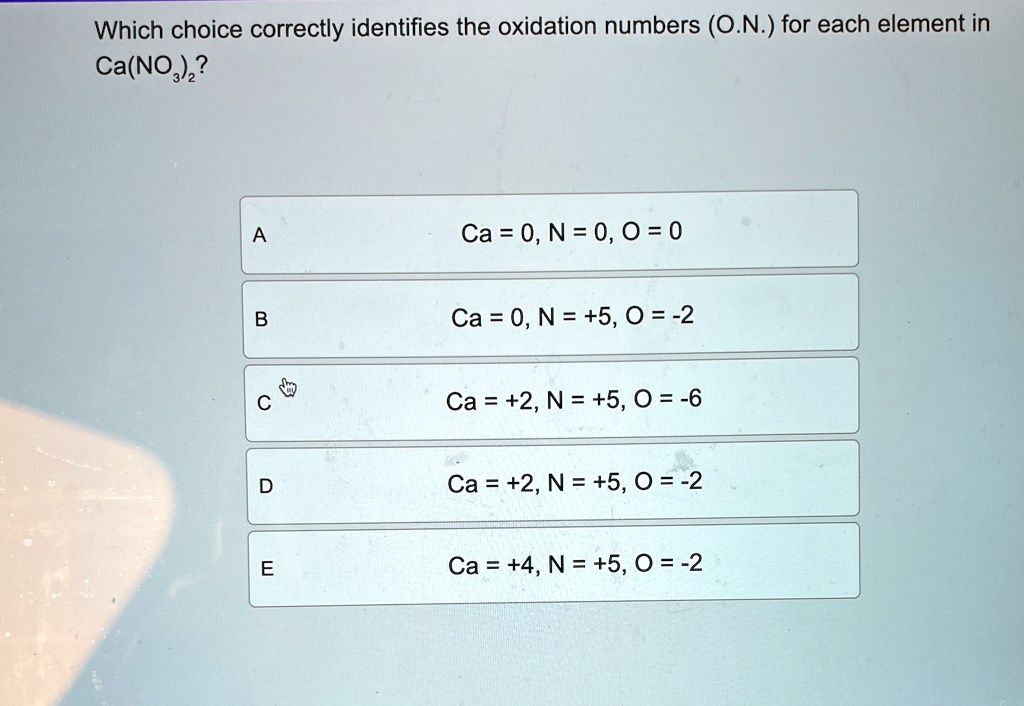
Which choice correctly identifies the oxidation numbers (O.N.) for each element in Ca(NO$_3$)$_2$? A Ca = 0, N = 0, O = 0 B Ca = 0, N = +5, O = -2 C Ca = +2, N = +5, O = -6 D Ca = +2, N = +5, O = -2 E Ca = +4, N = +5, O = -2
Which of the following is an example of direct evidence? a shoe print matching the same style and size as a shoe owned by the defendant a boyfriend's fingerprint in his girlfriend's car a carpet fiber from the defendant's van that was the same type as one found on the victim an accomplice's confession that they saw the defendant murder the victim
Calculate the volume of 0.230-M NaOH solution needed to completely neutralize 68.8 mL of a 0.270-M solution of the diprotic acid H2SO4. mL NaOH
The two types of fluid deficiencies are volume depletion and .
the U shape of the SAC and LAC curves depends on the interplay between fixed costs, variable costs, total costs, and marginal costs as production levels change.
There is only one position for the formula being calculated in a Data Table analysis regardless of whether there are one or two variables. O True O False
Which of the following are parametric equations for the entire line $y = x + 1$? Choose all that apply. Get Help: Video $x(t) = t + 2, y(t) = t + 3$ $x(t) = t + 2, y(t) = t + 3$ $x(t) = t - 1, y(t) = t$ $x(t) = \cos(t), y(t) = \cos^2(t) + 1$ $x(t) = t + 1, y(t) = t$ $x(t) = t, y(t) = t + 1$ $x(t) = t^2, y(t) = t + 1$ $x(t) = \tan(t), y(t) = \tan(t) + 1$ $x(t) = t^3, y(t) = t^3 + 1
Problem 4: (%25) Consider the following control system. R(s) K 2s+1 1 C(s) S Kh a) Obtain the closed loop transfer function C(s)/R(s). b) Determine the gains K and K<sub>h</sub> such that the closed-loop system has a damping ratio of \(\zeta = 1/\sqrt{2}\) and has an undamped natural frequency of \(\omega_n = 2\sqrt{2}\) rad/s. c) Obtain the step response of the closed loop system, that is, obtain c(t) for r(t) = 1.