Ace - AI Tutor
Ask Our Educators
Textbooks
My Library
Flashcards
Scribe - AI Notes
Notes & Exams
Download App
madeline villar

madeline v.

Divider

Questions asked

BEST MATCH

Theorem 2-4: Suppose that \{a_n\} and \{b_n\} are sequences of real numbers such that \{a_n\} \to a and \{b_n\} \to b. Then (a) \{a_n + b_n\} \to a + b. (b) \{ca_n\} \to ca for any number c. (c) \{a_n b_n\} \to ab. (d) If $b \neq 0$ and $b_n \neq 0$ for any n, then \{a_n/b_n\} \to a/b.

View Answer
divider
BEST MATCH

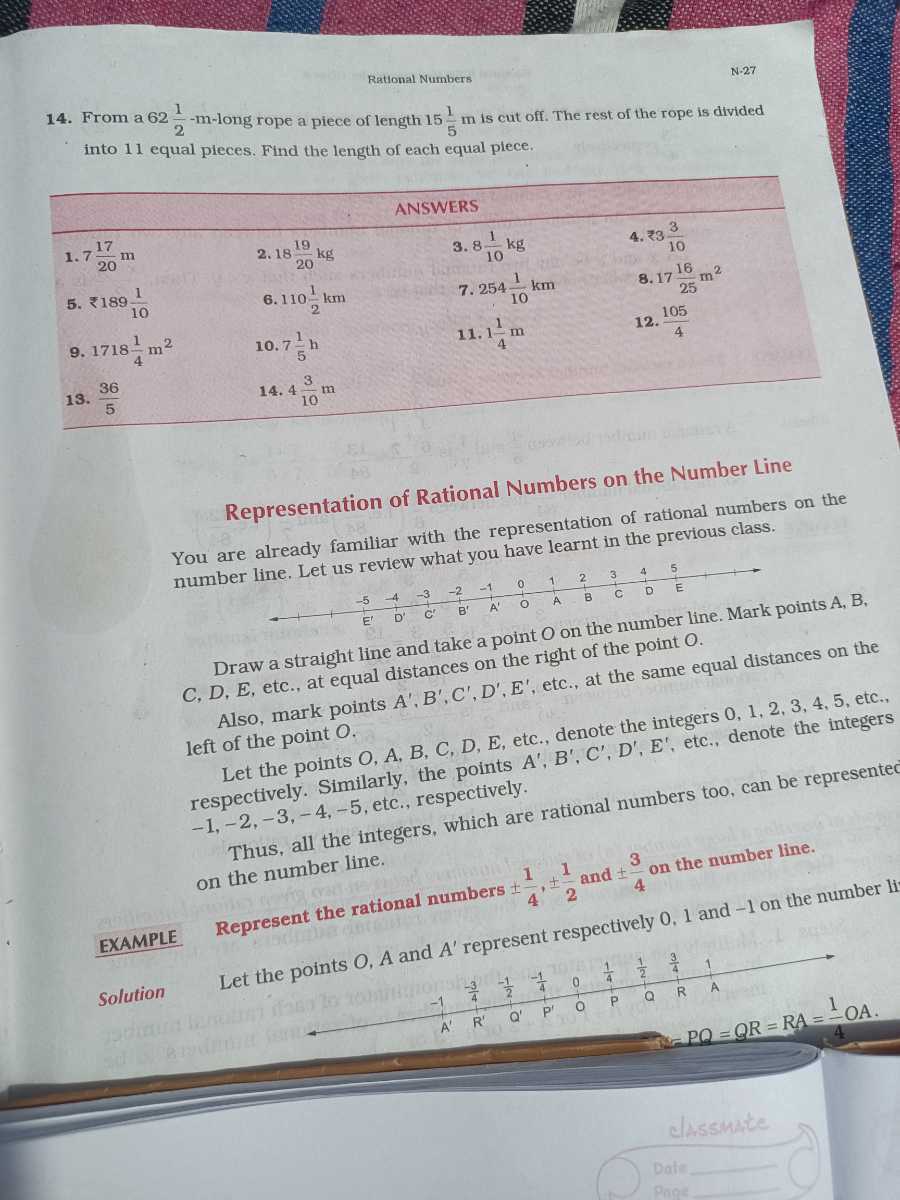
Rational Numbers \( \mathrm{N} \cdot 27 \) 14. From a \( 62 \frac{1}{2}-\mathrm{m} \)-long rope a piece of length \( 15 \frac{1}{5} \mathrm{~m} \) is cut off. The rest of the rope is divided into 11 equal pleces. Find the length of each equal plece. 1. \( 7 \frac{17}{20} \mathrm{~m} \) 2. \( 18 \frac{19}{20} \mathrm{~kg} \) ANSWERS 5. ? \( 189 \frac{1}{10} \) 6. \( 110 \frac{1}{2} \mathrm{~km} \) 9. \( 1718 \frac{1}{4} \mathrm{~m}^{2} \) 10. \( 7 \frac{1}{5} \mathrm{~h} \) 3. \( 8 \frac{1}{10} \mathrm{~kg} \) 4. ? \( ? \frac{3}{10} \) 13. \( \frac{36}{5} \) 14. \( 4 \frac{3}{10} \mathrm{~m} \) 7. \( 254 \frac{1}{10} \mathrm{~km} \) \( 8.17 \frac{16}{25} \mathrm{~m}^{2} \) 11. \( 1 \frac{1}{4} \mathrm{~m} \) 12. \( \frac{105}{4} \) Representation of Rational Numbers on the Number Line You are already familiar with the representation of rational numbers on the number line. Let us review what you have learnt in the previous class. Draw a straight line and take a point \( O \) on the number line. Mark points \( A, B \), \( C, D, E \), etc., at equal distances on the right of the point \( O \). Also, mark points \( A^{\prime}, B^{\prime}, C^{\prime}, D^{\prime}, E^{\prime} \), etc., at the same equal distances on the left of the point \( O \). Let the points \( O, A, B, C, D, E \), etc., denote the integers \( 0,1,2,3,4,5 \), etc.. respectively. Similarly, the points \( A^{\prime}, B^{\prime}, C^{\prime}, D^{\prime}, E^{\prime} \), etc., denote the integers \( -1,-2,-3,-4,-5 \), etc., respectively. Thus, all the integers, which are rational numbers too, can be representec on the number line. EXAMPLE Represent the rational numbers \( \pm \frac{1}{4}, \pm \frac{1}{2} \) and \( \pm \frac{3}{4} \) on the number line. Solution Let the points \( O, A \) and \( A^{\prime} \) represent respectively 0,1 and -1 on the number li \[ \begin{array}{l} \xrightarrow{\begin{array}{rrrrrrrrrrr} & \frac{-3}{4} & -\frac{1}{2} & \frac{-1}{4} & 0 & \frac{1}{4} & \frac{1}{2} & \frac{3}{4} & 1 \\ \hline \end{array}} \\ P Q=Q R=R A=\frac{1}{4} O A . \\ \end{array} \]
View Answer
divider
BEST MATCH

Identify the tissues where you would find chondrocytes. Elastic connective tissue and fibrocartilage Hyaline cartilage and spongy bone Hyaline cartilage and compact bone Elastic cartilage and hyaline cartilage Elastic cartilage and adipose tissue

View Answer
divider
BEST MATCH

Evaluate the expression without using a calculator. \log(0.001) \log(0.001) =

View Answer
divider
BEST MATCH

After graduating with a master's degree, María Fernanda combined all of her student loans into a single loan of $26,000.00 with an interest rate of 3.2% compounded quarterly. If she is planning to pay off the loan in 11 years, what will her quarterly payment be? The quarterly payment would be $. (Round to 2 decimal places.)

View Answer
divider
BEST MATCH

Up until now we have been examining the radioactive decay moving forward in time. However, when determining the age of a rock or geologic event we must work backwards from the present. Given the following knowledge, the age of a rock can be calculate. 1. The amounts of parent and daughter in a crystal 2. Knowledge of the half-life of the parent isotope. Calculating the age of a rock: • Using the graph you make in the previous question and the table below, determine the age of the muscovite and zircon minerals. Hint: start by applying these known $N_d/N_p$ ratios to your graph to determine the number of half-lives elapsed. Decay Series $N_d/N_p$ Half-lives elapsed Half-life (yr) Age (yr) muscovite $^{40}K \rightarrow ^{40}Ar$ 3.7 $1.25 \times 10^9$ zircon $^{235}U \rightarrow ^{207}Pb$ 15 $0.704 \times 10^9$

View Answer
divider
BEST MATCH

Please use the values in the resources listed below instead of the textbook values. Complete the changes in concentrations for each of the following reactions. (a) Cr(CN)$_{3}$(s) \(\implies\) Cr$^{3+}$(aq) + 3 CN$^{-}$(aq) Reaction Cr(CN)$_{3}$(s) = Cr$^{3+}$(aq) + 3 CN$^{-}$(aq) relative change +x +2 +3x (b) Ti$_{2}$CO$_{3}$(s) \(\implies\) 2 Ti$^{+}$(aq) + CO$_{3}$$^{2-}$(aq) Reaction Ti$_{2}$CO$_{3}$(s) = 2 Ti$^{+}$(aq) + CO$_{3}$$^{2-}$(aq) relative change +x (c) CaC$_{2}$O$_{4}$(s) \(\implies\) Ca$^{2+}$(aq) + C$_{2}$O$_{4}$$^{2-}$(aq) Reaction CaC$_{2}$O$_{4}$(s) = Ca$^{2+}$(aq) + C$_{2}$O$_{4}$$^{2-}$(aq) relative change +x (d) Ni(OH)NO$_{3}$(s) \(\implies\) Ni$^{2+}$(aq) + OH$^{-}$(aq) + NO$_{3}$$^{-}$(aq) Reaction Ni(OH)NO$_{3}$(s) = Ni$^{2+}$(aq) + OH$^{-}$(aq) + NO$_{3}$$^{-}$(aq) relative change +x (e) Zr$_{3}$(VO$_{4}$)$_{4}$(s) \(\implies\) 3 Zr$^{4+}$(aq) + 4 VO$_{4}$$^{3-}$(aq) Reaction Zr$_{3}$(VO$_{4}$)$_{4}$(s) = 3 Zr$^{4+}$(aq) + 4 VO$_{4}$$^{3-}$(aq) relative change +3x

View Answer
divider
BEST MATCH

The switch in the circuit (Figure 1) has been open for a long time. At $t = 0$ the switch is closed. Part A Determine $i_o(0)$. Express your answer to three significant figures and include the appropriate units. $i_o(0) =$ Value Units Submit Request Answer Part B Determine $i_o(\infty)$. Express your answer to three significant figures and include the appropriate units. $i_o(\infty) =$ Value Units Submit Request Answer Part C Select the correct expression for $i_o(t)$ for $t \ge 0$. $\circ i_o(t) = e^{-500t}$ A $\circ i_o(t) = 2e^{-500t}$ A $\circ i_o(t) = 2e^{-250t}$ A $\circ i_o(t) = e^{-250t}$ A $\circ i_o(t) = 0.5e^{-250t}$ A $\circ i_o(t) = 0.5e^{-500t}$ A Submit Request Answer Part D How many milliseconds after the switch has been closed will $i_o$ equal 220 mA? Express your answer to three significant figures and include the appropriate units. t = Value Units Submit Request Answer

View Answer
divider
BEST MATCH

1. A ten-story building subject to ground motion can be modeled as a mass suspended by two 40 m high, 0.5 m thick, and 10 m wide walls parallel to each other (adapted from textbook). If the walls are made of concrete (modulus of elasticity 17 GPa) and the mass of the building is 100,000 kg, then calculate the maximum deflection of the top building when it is subject to a displacement of 0.1 m at the base with a frequency of 0.2 Hz. [5]

View Answer
divider
BEST MATCH

2 Write the following permutations as a product of disjoint cycles, and as a product of transpositions: (a) \begin{pmatrix} 1 & 2 & 3 & 4 & 5 & 6 & 7 & 8 & 9 & x \\ 7 & x & 3 & 2 & 8 & 9 & 6 & 5 & 1 & 4 \end{pmatrix} (b) \begin{pmatrix} 1 & 2 & 3 & 4 & 5 & 6 & 7 & 8 & 9 & x \\ 9 & 3 & 7 & 1 & 6 & 5 & 2 & x & 4 & 8 \end{pmatrix} (c) (abc)(cad) (d) (213)(3421)(153)

View Answer
divider