Finding the molar mass:
Worksheet 8-Chapter 8: The Mole Concept
A chemical compound is a combination of two or more elements that bond together in a specific ratio of atoms. As we now know, atoms, molecules, ions, and formula units are really small.
Examples:
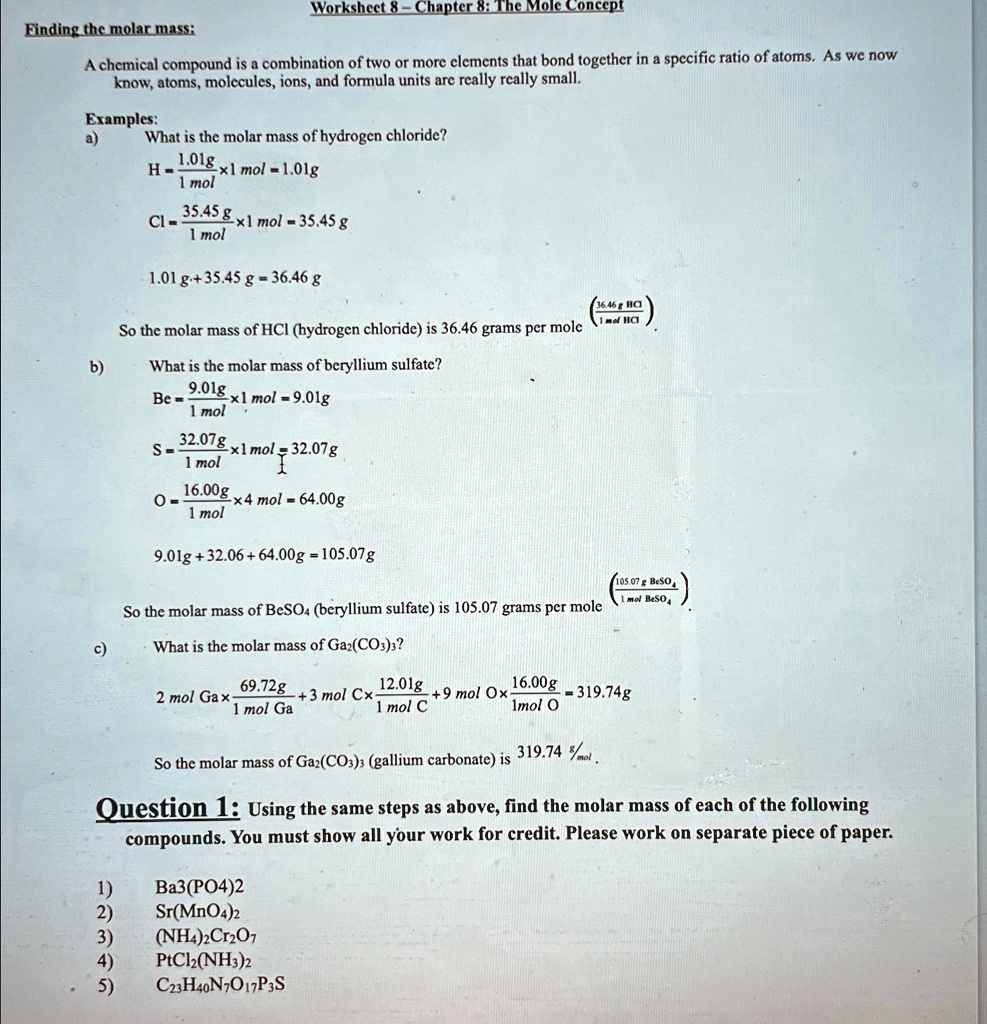
a) What is the molar mass of hydrogen chloride?
H=(1.01(g))/(1(mol))×1mol=1.01g
Cl=(35.45(g))/(1(mol))×1mol=35.45g
1.01g+35.45g=36.46g
So the molar mass of HCl (hydrogen chloride) is 36.46 grams per mole ((36.46(g)HCl)/(1-mol HCl)).
b) What is the molar mass of beryllium sulfate?
Be=(9.01(g))/(1(mol))×1mol=9.01g
S=(32.07(g))/(1(mol))×1mol=32.07g
O=(16.00(g))/(1(mol))×4mol=64.00g
9.01g+32.07g+64.00g=105.07g
So the molar mass of BeSO4 (beryllium sulfate) is 105.07 grams per mole ((105.07(g)BeSO4)/(1 mol BeSO4)).
c) What is the molar mass of Ga2(CO3)3?
2mol Ga×(69.72(g))/(1(mol) Ga)+3mol C×(12.01(g))/(1(mol) C)+9mol O×(16.00(g))/(1(mol) O)=319.74g
So the molar mass of Ga2(CO3)3 (gallium carbonate) is 319.74(g)/(mol).
Question 1: Using the same steps as above, find the molar mass of each of the following compounds. You must show all your work for credit. Please work on a separate piece of paper.
Ba3(PO4)2
Sr(MnO4)2
(NH4)2Cr2O7
PtCl2(NH3)2
C23H40N7O17P3S
Worksheet 8-Chapter 8: The Mole Concept
Finding the molar mass: A chemical compound is a combination of two or more elements that bond together in a specific ratio of atoms. As we now know, atoms, molecules, ions, and formula units are really small.
Examples:
a) What is the molar mass of hydrogen chloride?
1 mol
1 mol
1.01 g+35.45 g=36.46 g
b) What is the molar mass of beryllium sulfate?
1 mol
1 mol
1 mol
9.01g+32.07g+64.00g=105.07g
105.07g BeSO4 1 mol BeSO4 So the molar mass of BeSO4 (beryllium sulfate) is 105.07 grams per mole
c) What is the molar mass of Ga2(CO3)3?
16.00g 319.74g 1 mol
2 mol Ga 1 mol Ga
1 mol C
So the molar mass of Ga2(CO3)3 (gallium carbonate) is 319.74 g/mol.
Question 1: Using the same steps as above, find the molar mass of each of the following compounds. You must show all your work for credit. Please work on a separate piece of paper.
1) 2) 3) 4) 5)
Ba3(PO4)2 Sr(MnO4)2 (NH4)2Cr2O7 PtCl2(NH3)2 C23H40N7O17P3S