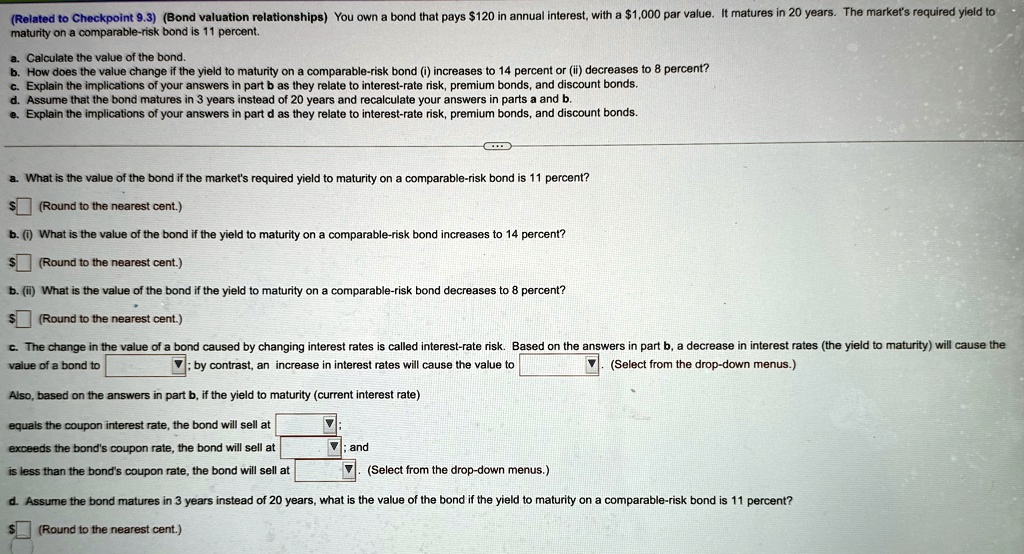
maturity on a comparable-risk bond is 11 percent.
a. Calculate the value of the bond.
b. How does the value change if the yield to maturity on a comparable-risk bond (i) increases to 14 percent or (ii) decreases to 8 percent?
c. Explain the implications of your answers in part b as they relate to interest-rate risk, premium bonds, and discount bonds.
d. Assume that the bond matures in 3 years instead of 20 years and recalculate your answers in parts a and b.
e. Explain the implications of your answers in part d as they relate to interest-rate risk, premium bonds, and discount bonds.
a. What is the value of the bond if the market's required yield to maturity on a comparable-risk bond is 11 percent?
(Round to the nearest cent.)
b. (i) What is the value of the bond if the yield to maturity on a comparable-risk bond increases to 14 percent?
(Round to the nearest cent.)
b. (ii) What is the value of the bond if the yield to maturity on a comparable-risk bond decreases to 8 percent?
(Round to the nearest cent.) value of a bond to by contrast, an increase in interest rates will cause the value tc (Select from the drop-down menus.)
Also, based on the answers in part b, if the yield to maturity (current interest rate)
equals the coupon interest rate, the bond will sell at
exceeds the bond's coupon rate, the bond will sell at and is less than the bond's coupon rate, the bond will sell at (Select from the drop-down menus.)
d. Assume the bond matures in 3 years instead of 20 years, what is the value of the bond if the yield to maturity on a comparable-risk bond is 11 percent?
(Round to the nearest cent.)
(Related to Checkpoint 9.3 Bond valuation relationships You own a bond that pays S120 in annual interest,with a $1,000 par value. It matures in 20 years. The market's required yield to maturity on a comparable-risk bond is 11 percent. a. Calculate the value of the bond. b. How does the value change if the yield to maturity on a comparable-risk bond increases to 14 percent or i decreases to 8 percent? Explain the implications of your answers in part b as they relate to interest-rate risk, premium bonds, and discount bonds. d. Assume that the bond matures in 3 years instead of 20 years and recalculate your answers in parts a and b. e. Explain the implications of your answers in part d as they relate to interest-rate risk, premium bonds,and discount bonds.
s(Round to the nearest cent.
b.i What is the value of the bond if the yield to maturity on a comparable-risk bond increases to 14 percent
sRound to the nearest cent.
b. What is the value of the bond if the yield to maturity on a comparable-risk bond decreases to 8 percent
SRound to the nearest cent.
c. The change in the value of a bond caused by changing interest rates is called interest-rate risk. Based on the answers in part b, a decrease in interest rates (the yield to maturity will cause the value of a bond to V;by contrast,an increase in interest rates will cause the value to Select from the drop-down menus.
Also, based on the answers in part b, if the yield to maturity (current interest rate)
equals the coupon interest rate, the bond will sell at exceeds the bond's coupon rate, the bond will sell at is iess than the bond's coupon rate, the bond will sell at
(Select from the drop-down menus.
d. Assume the bond matures in 3 years instead of 20 years,what is the value of the bond if the yield to maturity on a comparable-risk bond is 11 percent?
S(Round to the nearest cent.)