Where is the rest of the questions?
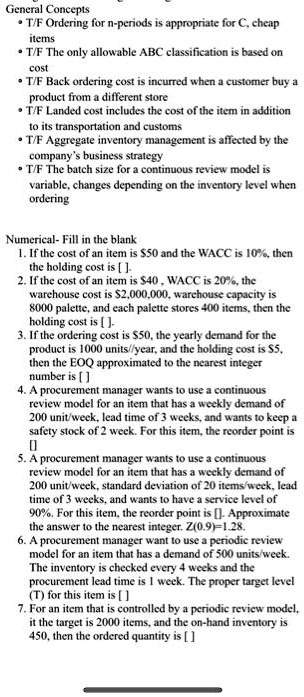
General Concepts T/F Ordering for n-periods is appropriate for cheap items. T/F The only allowable ABC classification is based on cost. T/F Backordering cost is incurred when a customer buys a product from a different store. T/F Landed cost includes the cost of the item in addition to its transportation and customs. T/F Aggregate inventory management is affected by the company's business strategy. T/F The batch size for a continuous review model is variable and changes depending on the inventory level when ordering.
Numerical-Fill in the blank 1. If the cost of an item is $50 and the WACC is 10%, then the holding cost is []. 2. If the cost of an item is $40, WACC is 20%, the warehouse cost is $2,000,000, warehouse capacity is 8,000 palettes, and each palette stores 400 items, then the holding cost is []. 3. If the ordering cost is $50, the yearly demand for the product is 1,000 units/year, and the holding cost is $5, then the EOQ approximated to the nearest integer number is []. 4. A procurement manager wants to use a continuous review model for an item that has a weekly demand of 200 units/week, lead time of 3 weeks, and wants to keep a safety stock of 2 weeks. For this item, the reorder point is []. 5. A procurement manager wants to use a continuous review model for an item that has a weekly demand of 200 units/week, standard deviation of 20 items/week, lead time of 3 weeks, and wants to have a service level of 90%. For this item, the reorder point is []. Approximate the answer to the nearest integer. Z0.9 = 1.28. 6. A procurement manager wants to use a periodic review model for an item that has a demand of 500 units/week. The inventory is checked every 4 weeks and the procurement lead time is 1 week. The proper target level T for this item is []. 7. For an item that is controlled by a periodic review model, if the target is 2,000 items and the on-hand inventory is 450, then the ordered quantity is [].