Base your answers to questions 31 through 33 on the information below and on your knowledge of chemistry.
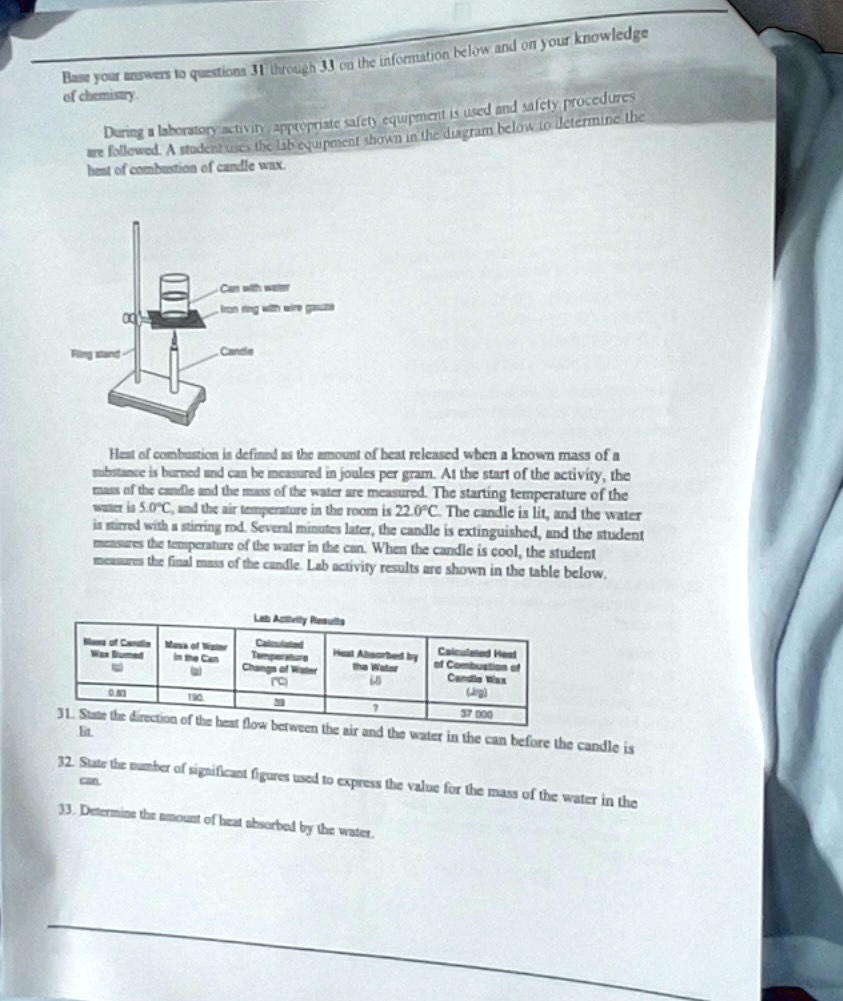
During a laboratory activity, appropriate safety equipment is used and safety procedures are followed. A student uses the lab equipment shown in the diagram below to determine the heat of combustion of candle wax.
Ring stand
Can with water
Iron ring with wire gauze
Candle
Heat of combustion is defined as the amount of heat released when a known mass of a substance is burned and can be measured in joules per gram. At the start of the activity, the mass of the candle and the mass of the water are measured. The starting temperature of the water is 5.0"C, and the air temperature in the room is 22.0"C. The candle is lit, and the water is stirred with a stirring rod. Several minutes later, the candle is extinguished, and the student measures the temperature of the water in the can. When the candle is cool, the student measures the final mass of the candle. Lab activity results are shown in the table below.
Lab Activity Results
Mass of Candle Wax Burned (g): 0.83
Mass of Water in the Can (g): 190.
Calculated Temperature Change of Water ("C): 30
Heat Absorbed by the Water (J): ?
Calculated Heat of Combustion of Candle Wax (J/g): 37 000
31. State the direction of the heat flow between the air and the water in the can before the candle is lit.
32. State the number of significant figures used to express the value for the mass of the water in the can.
33. Determine the amount of heat absorbed by the water.