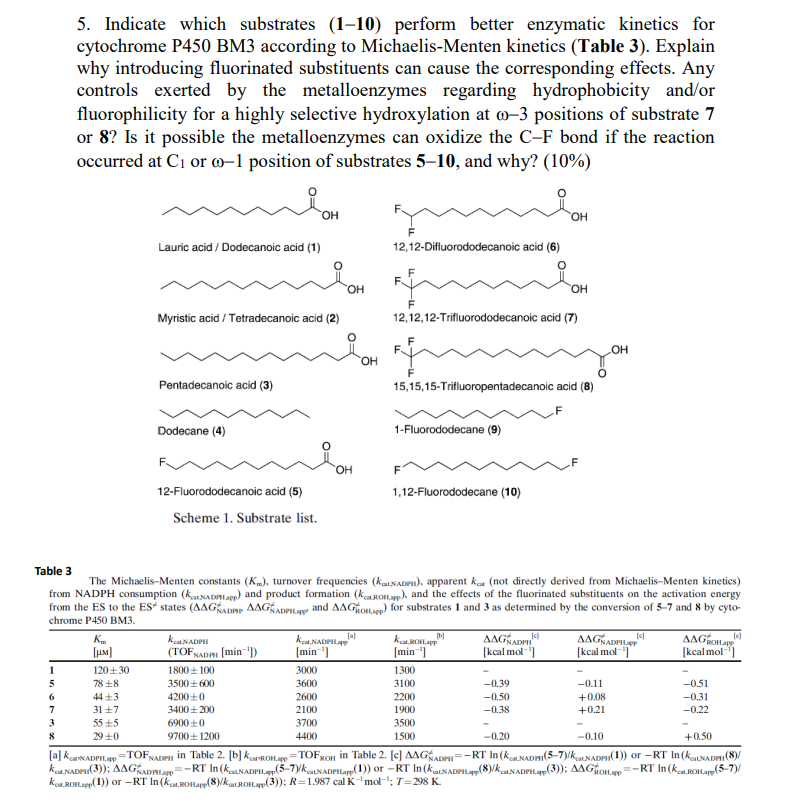
5. Indicate which substrates (1-10) perform better enzymatic kinetics for cytochrome P450 BM3 according to Michaelis-Menten kinetics (Table 3). Explain why introducing fluorinated substituents can cause the corresponding effects. Any controls exerted by the metalloenzymes regarding hydrophobicity and/or fluorophilicity for a highly selective hydroxylation at \( \omega-3 \) positions of substrate 7 or 8 ? Is it possible the metalloenzymes can oxidize the \( \mathrm{C}-\mathrm{F} \) bond if the reaction occurred at \( C_{1} \) or \( \omega-1 \) position of substrates \( 5-\mathbf{1 0} \), and why? (10\%)
Lauric acid / Dodecanoic acid (1)
Myristic acid / Tetradecanoic acid (2)
Pentadecanoic acid (3)
\( \overbrace{}^{\sim} \)
Dodecane (4)
12-Fluorododecanoic acid (5)
12,12-Difluorododecanoic acid (6)
12,12,12-Trifluorododecanoic acid (7)
15,15,15-Trifluoropentadecanoic acid (8)
\( { }^{N} \)
1-Fluorododecane (9)
1,12-Fluorododecane (10)
Scheme 1. Substrate list.
Table 3
The Michaelis-Menten constants \( \left(K_{\mathrm{m}}\right. \) ), turnover frequencies ( \( k_{\text {at:NaDpHi }} \) ), apparent \( k_{\mathrm{cat}} \) (not directly derived from Michaelis-Menten kinetics) from NADPH consumption ( \( k_{\text {catsidplapp }} \) ) and product formation ( \( k_{\text {cat,ROH,app }} \) ), and the effects of the fluorinated substituents on the activation energy chrome P450 BM3.
\begin{tabular}{|c|c|c|c|c|c|c|c|}
\hline & \begin{tabular}{l}
\( K_{\mathrm{m}} \) \\
{\( [\mu \mathrm{M}] \)} \\
\end{tabular} & \begin{tabular}{l}
\( k_{\text {cal,NADPH }} \) \\
\( \left(\right. \) TOF \( \left._{\text {NADPI }}\left[\mathrm{min}^{-1}\right]\right) \)
\end{tabular} & \begin{tabular}{l}
\( k_{\text {cat,NADPLLapp }}{ }^{[0]} \) \\
{\( \left[\mathrm{min}^{-1}\right] \)}
\end{tabular} & \begin{tabular}{l}
\( k_{\text {cat,BOH,app }}^{[\mathrm{b}]} \) \\
{\( \left[\mathrm{min}^{-1}\right] \)} \\
\end{tabular} & \begin{tabular}{l}
\( \triangle \Delta G_{\mathrm{NADPH}}^{f|c|} \) \\
{\( \left[\mathrm{kcal} \mathrm{mol}^{-1}\right] \)}
\end{tabular} & \begin{tabular}{l}
\( \Delta \Delta G_{\mathrm{NADPH} / \mathrm{pp}}^{f \epsilon]} \) \\
{\( \left[\mathrm{kcal} \mathrm{mol}^{-1}\right] \)}
\end{tabular} & \begin{tabular}{l}
\( \left.\Delta \Delta G_{\mathrm{kOH} \text { ap }}^{f \epsilon \epsilon}\right] \) \\
{\( \left[\mathrm{kcal} \mathrm{mol}^{-1}\right] \)} \\
\end{tabular} \\
\hline 1 & \( 120 \pm 30 \) & \( 1800 \pm 100 \) & 3000 & 1300 & - & - & - \\
\hline 5 & \( 78 \pm 8 \) & \( 3500 \pm 600 \) & 3600 & 3100 & -0.39 & -0.11 & -0.51 \\
\hline 6 & \( 44 \pm 3 \) & \( 4200 \pm 0 \) & 2600 & 2200 & -0.50 & +0.08 & -0.31 \\
\hline 7 & \( 31 \pm 7 \) & \( 3400 \pm 200 \) & 2100 & 1900 & -0.38 & +0.21 & -0.22 \\
\hline 3 & \( 55 \pm 5 \) & \( 6900 \pm 0 \) & 3700 & 3500 & - & - & - \\
\hline 8 & \( 29 \pm 0 \) & \( 9700 \pm 1200 \) & 4400 & 1500 & -0.20 & -0.10 & +0.50 \\
\hline
\end{tabular}
\( [\mathrm{a}] k_{\text {canNADPH,aqp }}=\mathrm{TOF}_{\text {NADPH }} \) in Table 2. [b] \( k_{\text {carRKOH,aqp }}=\mathrm{TOF}_{\text {ROH }} \) in Table 2. [c] \( \Delta \triangle G_{\text {NADPH }}=-\mathrm{RT} \ln \left(k_{\text {can,NADFH }}(5-7) / k_{\text {catNADPH }}(1)\right) \) or \( -\mathrm{RT} \ln \left(k_{\text {caLNADFH }}(8) /\right. \)