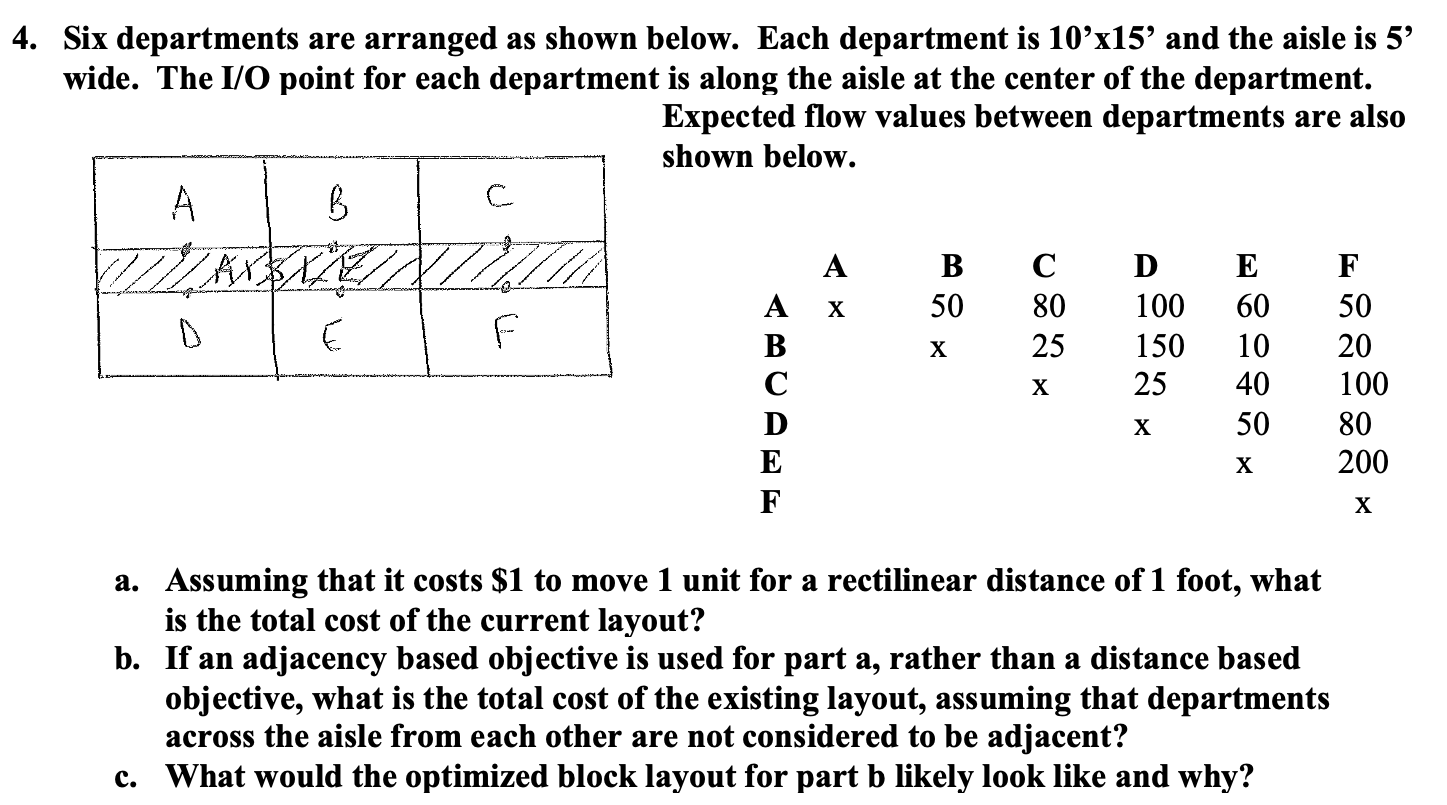
4. Six departments are arranged as shown below. Each department is \( 10^{\prime} \times 15^{\prime} \) and the aisle is \( 5^{\prime} \) wide. The \( \mathrm{I} / \mathrm{O} \) point for each department is along the aisle at the center of the department. Expected flow values between departments are also shown below.
\begin{tabular}{lllllll}
& \( \mathbf{A} \) & \( \mathbf{B} \) & \( \mathbf{C} \) & \( \mathbf{D} \) & \( \mathbf{E} \) & \( \mathbf{F} \) \\
\( \mathbf{A} \) & \( \mathbf{X} \) & 50 & 80 & 100 & 60 & 50 \\
\( \mathbf{B} \) & & \( \mathbf{x} \) & 25 & 150 & 10 & 20 \\
C & & & \( \mathbf{x} \) & 25 & 40 & 100 \\
D & & & & \( \mathbf{x} \) & 50 & 80 \\
E & & & & & \( \mathbf{x} \) & 200 \\
F & & & & & & \( \mathbf{x} \)
\end{tabular}
a. Assuming that it costs \( \$ 1 \) to move 1 unit for a rectilinear distance of 1 foot, what is the total cost of the current layout?
b. If an adjacency based objective is used for part a, rather than a distance based objective, what is the total cost of the existing layout, assuming that departments across the aisle from each other are not considered to be adjacent?
c. What would the optimized block layout for part b likely look like and why?