Ace - AI Tutor
Ask Our Educators
Textbooks
My Library
Flashcards
Scribe - AI Notes
Notes & Exams
Download App
Manal Mansour

Manal M.

Divider

Questions asked

ANSWERED

Isaac Huidobro verified

Numerade educator

IO3- + Re ? ReO4- + IO-

View Answer
divider
ANSWERED

Lijeesh Krishnan verified

Numerade educator

A positive number for maximum useful work in a spontaneous process (voltaic cell) indicates that the cell will perform work on its surroundings.

View Answer
divider
ANSWERED

Nishant Kumar verified

Numerade educator

The standard reduction potential of X is 1.23 V and that of Y is -0.44 V therefore X is oxidized by Y.

View Answer
divider
ANSWERED

Qudsiya Anis verified

Numerade educator

TRUE/FALSE. Write 'T' if the statement is true and 'F' if the statement is false. 39) The standard reduction potential, E°red, is proportional to the stoichiometric coefficient.

View Answer
divider
ANSWERED

Lijeesh Krishnan verified

Numerade educator

The quantity of charge passing a point in a circuit in one second when the current is one ampere is called a __________ .

View Answer
divider
ANSWERED

Isaac Huidobro verified

Numerade educator

23) Consider an electrochemical cell based on the reaction: 2H+ (aq) + Sn (s) ? Sn2+ (aq) + H2 (g) Which of the following actions would change the measured cell potential? A) increasing the [Sn2+] in the anode compartment B) increasing the pressure of hydrogen gas in the cathode compartment C) lowering the pH in the cathode compartment D) increasing the pH in the cathode compartment E) Any of the above will change the measure cell potential.

View Answer
divider
ANSWERED

Susan Hallstrom verified

Numerade educator

Table 20.2 Half-reaction | E° (V) Cr3+ (aq) + 3e- ? Cr (s) | -0.74 Fe2+ (aq) + 2e- ? Fe (s) | -0.440 Fe3+ (aq) + e- ? Fe2+ (s) | +0.771 Sn4+ (aq) + 2e- ? Sn2+ (aq) | +0.154 22) Which of the following reactions will occur spontaneously as written? A) 3Sn4+ (aq) + 2Cr (s) ? 2Cr3+ (aq) + 3Sn2+ (aq) B) 3Fe2+ (aq) ? Fe (s) + 2Fe3+ (aq) C) Sn4+ (aq) + Fe3+ (aq) ? Sn2+ (aq) + Fe2+ (aq) D) Sn4+ (aq) + Fe2+ (aq) ? Sn2+ (aq) + Fe (s) E) 3Fe (s) + 2Cr3+ (aq) ? 2Cr (s) + 3Fe2+ (aq)

View Answer
divider
ANSWERED

Susan Hallstrom verified

Numerade educator

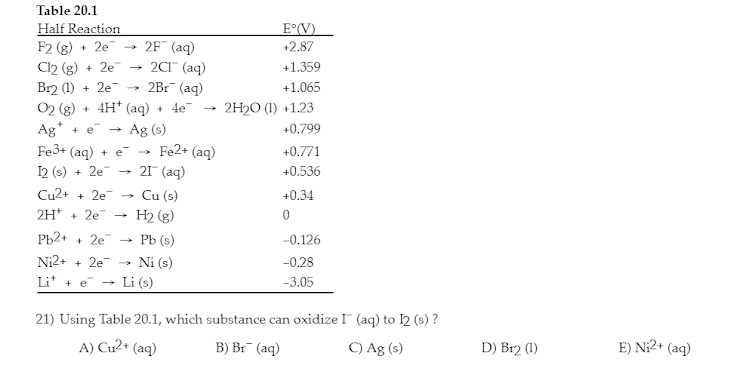
Table 20.1 Half Reaction E°(V) F2 (g) + 2e- ? 2F- (aq) +2.87 Cl2 (g) + 2e- ? 2Cl- (aq) +1.359 Br2 (l) + 2e- ? 2Br- (aq) +1.065 O2 (g) + 4H+ (aq) + 4e- ? 2H2O (l) +1.23 Ag+ + e- ? Ag (s) +0.799 Fe3+ (aq) + e- ? Fe2+ (aq) +0.771 I2 (s) + 2e- ? 2I- (aq) +0.536 Cu2+ + 2e- ? Cu (s) +0.34 2H+ + 2e- ? H2 (g) 0 Pb2+ + 2e- ? Pb (s) -0.126 Ni2+ + 2e- ? Ni (s) -0.28 Li+ + e- ? Li (s) -3.05 21) Using Table 20.1, which substance can oxidize I- (aq) to I2 (s) ? A) Cu2+ (aq) B) Br- (aq) C) Ag (s) D) Br2 (l) E) Ni2+ (aq)
View Answer
divider
ANSWERED

Qudsiya Anis verified

Numerade educator

18) Which transformation could take place at the cathode of an electrochemical cell? A) Br2 ? BrO3? B) NO ? HNO2 C) HSO4? ? H2SO3 D) MnO2 ? MnO4? E) Mn2+ ? MnO4?

View Answer
divider
INSTANT ANSWER

Which is right

View Answer
divider