Ace - AI Tutor
Ask Our Educators
Textbooks
My Library
Flashcards
Scribe - AI Notes
Notes & Exams
Download App
mandy thomas

mandy t.

Divider

Questions asked

BEST MATCH

Evaluate the definite integral. \int_0^((\pi )/(2)) 2cos(x)sin(sin(x))dx

View Answer
divider
BEST MATCH

A simple random sample of size nequals=3636 is obtained from a population that is skewed right with mu equals 77μ=77 and sigma equals 18σ=18. (a) Describe the sampling distribution of x overbarx. (b) What is Upper P left parenthesis x overbar greater than 80.3 right parenthesisP x>80.3? (c) What is Upper P left parenthesis x overbar less than or equals 70.4 right parenthesisP x≤70.4? (d) What is Upper P left parenthesis 73.4 less than x overbar less than 81.65 right parenthesisP 73.4

View Answer
divider
BEST MATCH

When preparing a patient for an ABG, what are two teaching tips you would provide to ensure a successful experience?

View Answer
divider
BEST MATCH

the jet plane will emit how many decibles at 8.2*10^2 watts per square meter

View Answer
divider
BEST MATCH

2 Fill in the Blank 1 point Find the quadratic function with the given vertex and point. Write your answer in standard form \( \left(a(x-h)^{2}+k\right) \) use ^ for exponents DO NOT put any spaces \[ f(x)=-2(x-3) \wedge 2+2 \]

View Answer
divider
BEST MATCH

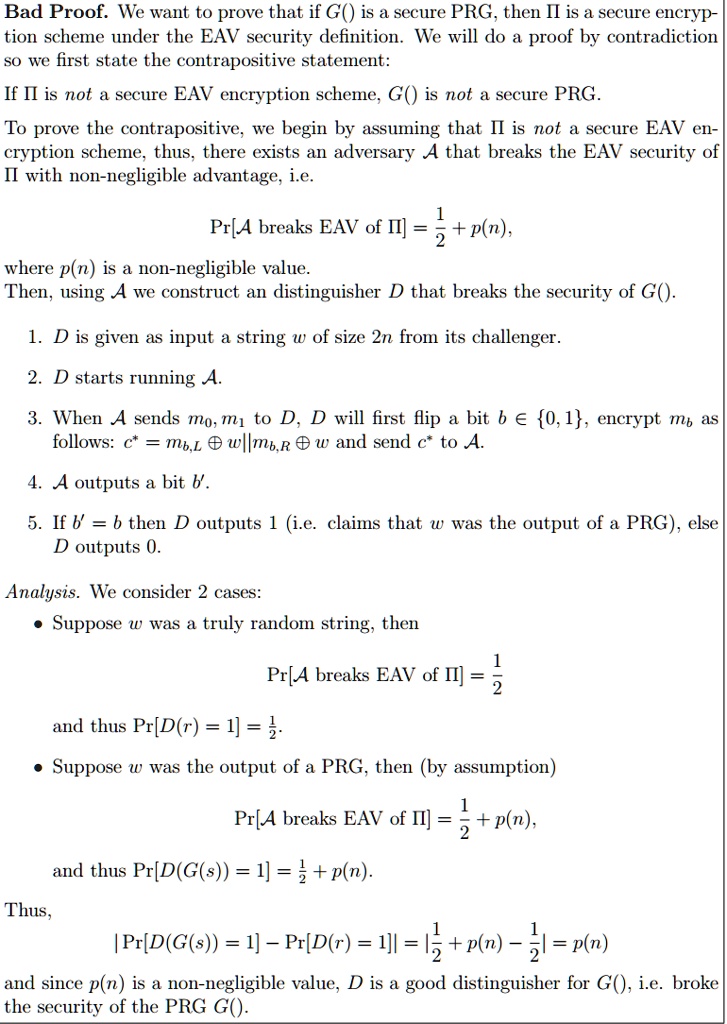
Bad Proof. We want to prove that if G() is a secure PRG, then Pi is a secure encryp- tion scheme under the EAV security definition. We will do a proof by contradiction so we first state the contrapositive statement: If Pi is not a secure EAV encryption scheme, G() is not a secure PRG. To prove the contrapositive, we begin by assuming that Pi is not a secure EAV en- cryption scheme, thus, there exists an adversary A that breaks the EAV security of II with non-negligible advantage, i.e. Pr[A breaks EAV of Pi ]=(1)/(2)+p(n), where p(n) is a non-negligible value. Then, using A we construct an distinguisher D that breaks the security of G(). D is given as input a string w of size 2n from its challenger. D starts running A. When A sends m_(0),m_(1) to D,D will first flip a bit bin{0,1}, encrypt m_(b) as follows: c^(**)=m_(b,L)o+w||m_(b,R)o+w and send c^(**) to A. A outputs a bit b^('). If b^(')=b then D outputs 1 (i.e. claims that w was the output of a PRG), else D outputs 0 . Analysis. We consider 2 cases: Suppose w was a truly random string, then Pr[A breaks EAV of Pi ]=(1)/(2) and thus Pr[D(r)=1]=(1)/(2). Suppose w was the output of a PRG, then (by assumption) Pr[A breaks EAV of Pi ]=(1)/(2)+p(n), and thus Pr[D(G(s))=1]=(1)/(2)+p(n). Thus, |Pr[D(G(s))=1]-Pr[D(r)=1]|=|(1)/(2)+p(n)-(1)/(2)|=p(n) and since p(n) is a non-negligible value, D is a good distinguisher for G(), i.e. broke the security of the PRG G(). Bad Proof. We want to prove that if GO is a secure PRG, then II is a secure encryp tion scheme under the EAV security definition. We will do a proof by contradiction so we first state the contrapositive statement: If II is not a secure EAV encryption scheme, GO is not a secure PRG. To prove the contrapositive, we begin by assuming that II is not a secure EAV en cryption scheme, thus, there exists an adversary A that breaks the EAV security of II with non-negligible advantage, i.e. Pr[A breaks EAV of II] = + p(n), where p(n) is a non-negligible value. Then, using A we construct an distinguisher D that breaks the security of GQ 1. D is given as input a string w of size 2n from its challenger. 2. D starts running A. 3. When A sends mo,mi to D, D will first flip a bit b e {0,1}, encrypt mo as follows: c* = mb,L w|mb,R w and send c* to A. 4. A outputs a bit b. 5. If b' = b then D outputs 1 (i.e. claims that w was the output of a PRG), else D outputs 0. Analysis. We consider 2 cases: . Suppose w was a truly random string, then Pr[A breaks EAV of II] = and thus Pr[D(r) = 1] = 2 Suppose w was the output of a PRG, then (by assumption) and thus Pr[D(G(s))=1]=+p(n) Thus, |Pr[D(G(s))=1]-Pr[D(r)=1]|=|+pn)-|=p(n and since p(n) is a non-negligible value, D is a good distinguisher for GO, i.e. broke the security of the PRG GO).
View Answer
divider
BEST MATCH

Find the limit.\\ \( \lim_{t \to 0} \tan \left( \frac{7}{4} \pi - \frac{\pi \sin t}{t} \right) \)

View Answer
divider
BEST MATCH

Texts: A traveling wave on a thin wire is given by the equation 𝑦 = (0.112 𝑚)sin (4.35𝑥 − 46.7𝑡), where all values are in appropriate SI units. (a) What is the propagation speed of this wave? (b) If the linear mass density of the string is 3.2 × 10^-3 𝑘𝑔/𝑚, what is the tension in the string?

View Answer
divider
BEST MATCH

A 1 to 4 dilution of a sample must be performed, with a total volume of 200 uL. How much serum would be needed?

View Answer
divider
BEST MATCH

ECE 374 Lab 2: Subtract Instruction Due: In Lab Feb 4, 2020 In this lab, you will be required to implement subtract (sub) instruction. Pre-Lab: To be done before coming to the lab (CAD simulation) 1) Modify the VHDL code from Lab 1 to incorporate the subtract instruction. The updated processor implementation should be able to execute both add and sub instructions. 2) Subtract operation can be implemented using the ripple carry adder. The "ripple_carry.vhd" gives the VHDL code for the ripple carry adder. Modify this file so that the component works as an adder/subtracter. 3) Use the same add_sub control for subtraction but this time it needs to be 1 when we do subtraction and 0 for addition. The logic for the add_sub control signal is specified in the "instruction_decode.vhd" file. Modify this file to update the logic for the add_sub control signal. 4) Encode the instruction sequence given below and input this sequence into the instruction memory by modifying "instruction_memory.vhd" file: a. r1 \(\leftarrow\) r1 + r0 b. r2 \(\leftarrow\) r2 - r1 c. r3 \(\leftarrow\) r3 - r1 d. r4 \(\leftarrow\) r4 + r3 e. r5 \(\leftarrow\) r5 - r4 5) The registers in the register file ("register_file.vhd") should have the following initial values: a. r0 = 0 b. r1 = 1 c. r2 = 2 d. r3 = 3 e. r4 = 4 6) Compile and simulate your code to make sure that its behavior is correct. Lab: To be done in the lab (FPGA simulation) You will be using the clock of the FPGA as the clock for your simulation. Use the push button to pause before the next instruction is executed. Show the FPGA simulation to the TA which should display the current PC value and the output of each instruction on the LEDs.

View Answer
divider