Ace - AI Tutor
Ask Our Educators
Textbooks
My Library
Flashcards
Scribe - AI Notes
Notes & Exams
Download App
manuel clark

manuel c.

Divider

Questions asked

BEST MATCH

pp. 371-377 (2)/(4)/25;4745PM Matching Leg and Foot, Muscle Group #1 ORIGINS Distal two-thirds of lateral fibula Lateral condyle of the femur Lateral supracondylar line of femur Condyles of the femur, posterior surfaces Head of fibula and proximal two-thirds of lateral fibula Soleal line: proximal, posterior surface of tibia; and posteror aspect of head of fibula INSERTIONS 7. Base of the first metatarsal and medial cuneiform 8. Calcaneus via calcaneal tendon (3) 9. Proximal, posterior aspect of tibia 10. Tuberosity of fifth metatarsal Shorten or Lengthen? 11. Passive dorsiflexion of the ankle would. â—» the soleus. 12. Passive lateral rotation of the knee woul â—» the popliteus. 13. Passive inversion of the foot would â—» the fibularis longus. 14. Passive flexion of the knee would â—» the gastrocnemius. Let's Palpate! Remember-there are no right or wrong answers here. Locate and explore the gastrocnemius and soleus on three individuals. Then write three words that describe what you feel. (See pp. 371 - 373 in Trall Guide.) Person #1 Person #2 q, q, q, â—» q, q, Leg

View Answer
divider
BEST MATCH

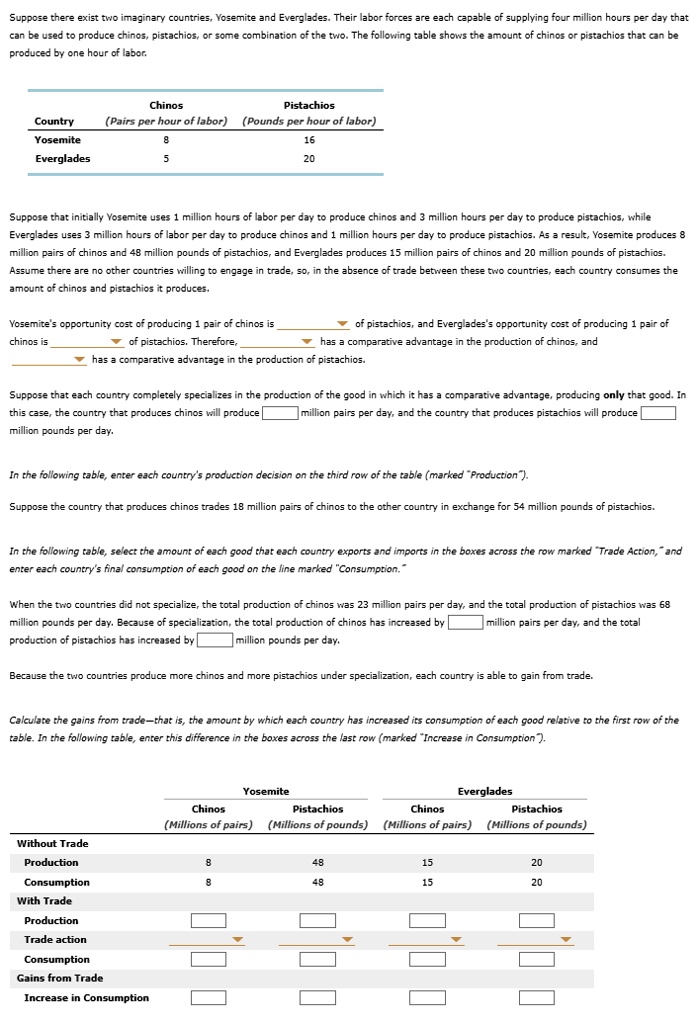
Suppose there exist two imaginary countries, Yosemite and Everglades. Their labor forces are each capable of supplying four million hours per day that can be used to produce chinos, pistachios, or some combination of the two. The following table shows the amount of chinos or pistachios that can be produced by one hour of labor. Chinos Pistachios Country (Pairs per hour of labor) (Pounds per hour of labor) Yosemite 8 16 Everglades 5 20 Suppose that initially Yosemite uses 1 million hours of labor per day to produce chinos and 3 million hours per day to produce pistachios, while Everglades uses 3 million hours of labor per day to produce chinos and 1 million hours per day to produce pistachios. As a result, Yosemite produces 8 million pairs of chinos and 48 million pounds of pistachios, and Everglades produces 15 million pairs of chinos and 20 million pounds of pistachios. Assume there are no other countries willing to engage in trade, so, in the absence of trade between these two countries, each country consumes the amount of chinos and pistachios it produces. Yosemite's opportunity cost of producing 1 pair of chinos is $\boxed{2}$ of pistachios, and Everglades's opportunity cost of producing 1 pair of chinos is $\boxed{4/5}$ of pistachios. Therefore, $\boxed{Yosemite}$ has a comparative advantage in the production of chinos, and $\boxed{Everglades}$ has a comparative advantage in the production of pistachios. Suppose that each country completely specializes in the production of the good in which it has a comparative advantage, producing only that good. In this case, the country that produces chinos will produce $\boxed{20}$ million pairs per day, and the country that produces pistachios will produce $\boxed{80}$ million pounds per day. In the following table, enter each country's production decision on the third row of the table (marked "Production"). Suppose the country that produces chinos trades 18 million pairs of chinos to the other country in exchange for 54 million pounds of pistachios. In the following table, select the amount of each good that each country exports and imports in the boxes across the row marked "Trade Action," and enter each country's final consumption of each good on the line marked "Consumption." When the two countries did not specialize, the total production of chinos was 23 million pairs per day, and the total production of pistachios was 68 million pounds per day. Because of specialization, the total production of chinos has increased by $\boxed{17}$ million pairs per day, and the total production of pistachios has increased by $\boxed{12}$ million pounds per day. Because the two countries produce more chinos and more pistachios under specialization, each country is able to gain from trade. Calculate the gains from trade-that is, the amount by which each country has increased its consumption of each good relative to the first row of the table. In the following table, enter this difference in the boxes across the last row (marked "Increase in Consumption"). Without Trade Yosemite Everglades Production Chinos Pistachios Chinos Pistachios (Millions of pairs) (Millions of pounds) (Millions of pairs) (Millions of pounds) 8 48 15 20 Consumption 8 48 15 20 With Trade Production Trade action Consumption Gains from Trade Increase in Consumption
View Answer
divider
BEST MATCH

e) Determine the present value of an annuity due of $ 8 comma 000$8,000 per year for 88 years discounted back to the present at an annual rate of 77 percent. What would be the present value of this annuity due if it were discounted at an annual rate of 1212 percent?

View Answer
divider
BEST MATCH

Question 26 An antagonist is a drug that: ? always deceases maximum effect ? binds to the agonist to inactivate it ? binds to the receptor and doesn't do anything ? binds to the receptor and does the opposite of an agonist 1 pts

View Answer
divider
BEST MATCH

Evaluate the following integral.\\ $\int x^3 3^{x^4 + 8} dx$\\ $\int x^3 3^{x^4 + 8} dx = \boxed{}$

View Answer
divider
BEST MATCH

6. If the supply function in a market is Q = -10 + 10P and the demand function is 18 - 4P, and the government puts in a price floor at $3, what will the result be? No effect Shortage of 14 units Surplus of 14 units Surplus of 10 units

View Answer
divider
BEST MATCH

In 2010, the passage of the ____ Act removed the restriction on the paying of interest on demand deposits that had been established with Regulation Q. a) McCurdy b) Regulation Q Elimination c) Dodd-Frank Wall Street Reform and Consumer Protection d) Depository Institutions Deregulation and Monetary Control

View Answer
divider
BEST MATCH

Texts: USD-MXN Rate: 17.8403 MXN – EUR Rate: 0.0528 USD – EUR: 0.9424 Does Triangular Arbitrage hold? If so, how can you take advantage of it with $100,000? List all transactions. What is your arbitrage profit in dollars and as a percent? Ignore transaction costs and bid-ask spread for this exercise. Thank you. I will give a thumbs up.

View Answer
divider
BEST MATCH

Compute the directional derivative of the function $g(x,y) = \sin(x(3x - 2y))$ at the point $P(-1, -3)$ in the direction $\begin{pmatrix} \frac{8}{17} \\ \frac{15}{17} \end{pmatrix}$. Be sure to use a unit vector for the direction vector. The directional derivative is $oxed{}$ (Type an exact answer, using $\pi$ as needed.)

View Answer
divider
BEST MATCH

Find the limit of the following sequence or determine that the sequence diverges.\\ \begin{Bmatrix} \left(1 + \frac{5}{n}\right)^{n} \end{Bmatrix}\\ Select the correct choice below and, if necessary, fill in the answer box to complete your choice.\\ A. The limit of the sequence is (Type an exact answer.)\\ B. The sequence diverges.

View Answer
divider