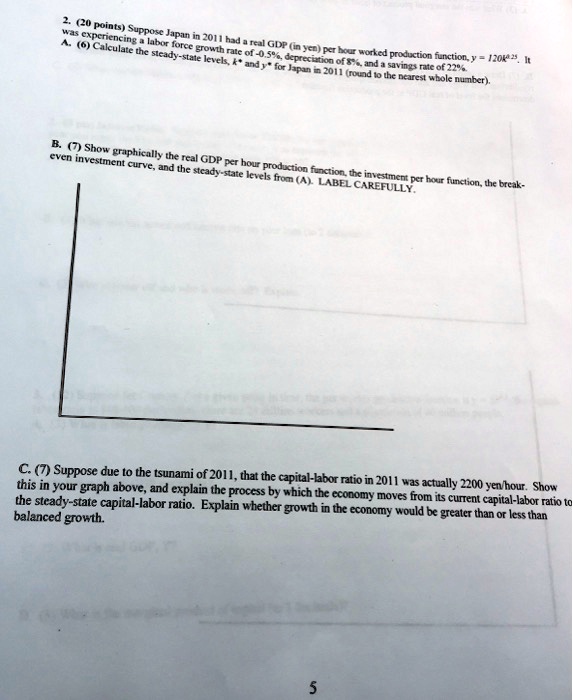
2. (20 points) Suppose Japan in 2011 had a real GDP (in yen) per hour worked production function, y = 120k$^{0.25}$. It
was experiencing a labor force growth rate of -0.5%, depreciation of 8%, and a savings rate of 22%.
A. (6) Calculate the steady-state levels, $k^*$ and $y^*$ for Japan in 2011 (round to the nearest whole number).
B. (7) Show graphically the real GDP per hour production function, the investment per hour function, the break-
even investment curve, and the steady-state levels from (A). LABEL CAREFULLY.
C. (7) Suppose due to the tsunami of 2011, that the capital-labor ratio in 2011 was actually 2200 yen/hour. Show
this in your graph above, and explain the process by which the economy moves from its current capital-labor ratio to
the steady-state capital-labor ratio. Explain whether growth in the economy would be greater than or less than
balanced growth.
5