Ace - AI Tutor
Ask Our Educators
Textbooks
My Library
Flashcards
Scribe - AI Notes
Notes & Exams
Download App
manuela ochoa

manuela o.

Divider

Questions asked

BEST MATCH

A slab of thickness L is subjected to a uniform flux q′′ on one side while the other side exchanges heat by convection along its outside surface with an ambient fluid at T∞. The heat transfer coefficient is h. The thermal conductivity of the slab depends on temperature according to: k(T ) = k0(1 − βT ) (1) where k0 and β are constant. Write the heat equation and boundary conditions for one-dimensional steady- state conduction. You do not need to solve this problem

View Answer
divider
BEST MATCH

A researcher administers a survey to a sample of college students in order to determine whether grade point average (GPA) and happiness are related. Drawing on an established theory of the relationship between achievement and emotion, she hypothesizes that these variables will be correlated. The data she collected support this hypothesis. This study involves which of the following processes? Deductive Reasoning Random Sampling Inductive Reasoning Qualitative Interviewing

View Answer
divider
BEST MATCH

HOMEWORK 22: Recursive Sum of Digits Write a function that is passed a number and returns the sum of its digits using recursion. For example: \( \cdot \) input: 21 \( \to \) output: 3 \( \cdot \) input: 687 \( \to \) output: 21 I'll give you a hint on the logic. The Mod operator can be a powerful tool. Let think through an example, let's say that n = 523, and we have 2 additional variables, temp and sum. This function could be easily executed with a Do-While Loop, but you must use recursion to get credit. first pass through the recursive loop temp = n Mod 10 'temp = 523 % 10 = 3 sum = sum + temp sum = 0 + 3 = 3 n = n - temp 'n = 523 - 3 = 520 n = n / 10 'n = 520 / 10 = 52 [do the recursive part] second pass through the recursive loop temp = n Mod 10 'temp = 52 % 10 = 2 sum = sum + temp sum = 3 + 2 = 5 n = n - temp 'n = 52 - 2 = 50 n = n / 10 'n = 50 / 10 = 5 [do the recursive part] third pass through the recursive loop temp = n Mod 10 'temp = 5 % 10 = 5 sum = sum + temp sum = 5 + 5 = 10 (the answer) n = n - temp 'n = 5 - 5 = 0 n = n / 10 'n = 0 / 10 = 0 [tell the code to stop now] Sum of Digits n Sum of Digits 5321

View Answer
divider
BEST MATCH

Principles of Macroeconomics: A Streamlined Approach, 3rd edition. Frank, Bernanke, Antonovics, Heffetz

View Answer
divider
BEST MATCH

How many students are taking a math course and 47 taking a cosc course. How many students are taking a math course and a cosc course? Question 17 (2 points) Consider the four functions shown: $A = n^2 \ln n$, $B = e^{2n}$, $C = 10^{n/2}$, $D = \frac{(n+2)!}{n!}$ Classify their rates of growth as $n \to +\infty$ from slowest to fastest by entering their labels (A,B,C,D) in the blanks. Slowest: Next faster: Fastest: Next faster: Question 18 (1 point) Which one of the following quadratics is irreducible?

View Answer
divider
BEST MATCH

1. Suppose there are 3 parallel running processes. They all share a variable D. Read-write operation are performed on D. [5 Marks] [CO-4] P1 P2 P2 D=D+20 D=D-50 D=D+10 a. The processes are executed on a uniprocessor system running in time-shared operating system. If the minimum and maximum possible values of D after the three processes have completed execution are X and Y respectively, then the value of Y - X is _____. Write process execution order to calculate X and Y.(Initialize D=100) b. Let the processing environment is multiprocessing then write a semaphore solution (pseudo code) to ensure the execution order P2, P1, and P3. Take the appropriate variable and initialized. 2. Consider the following snapshot of a system in which four resources A, B, C, and D are available. The system contains a total of 1 instance of A, 5 of resource B, 2 of resource C, and 2 of resource D. [5 Marks] [CO-2] Allocation Max Available A B C D A B C D A B C D P$_0$ 0 0 1 1 0 0 1 1 1 5 2 2 P$_1$ 1 0 0 1 1 7 5 1 P$_2$ 1 3 5 1 2 3 5 2 P$_3$ 0 5 3 1 1 6 5 2 P$_4$ 0 0 1 1 5 6 5 1 Answer the following question using Banker's algorithm. 1. What is the content of the need matrix? 2. Is the system in a safe state? If the system is safe, show how all the process could complete them execution successfully. If the system is unsafe, show how deadlock might occur. Explain. 3. If a request from P$_1$ arrives for (0,3,2,1), can the request be granted immediately? If yes or no write the sequence of step.

View Answer
divider
BEST MATCH

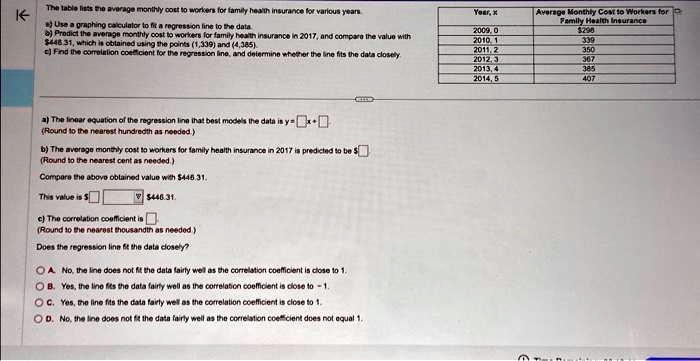
The table lists the average monthly cost to workers for family health insurance for various years Year, x Average Monthly Cost to Workers for Family Health insurance 8) Use a graphing calculator to fit a regression line to the data. b) Predict the average monthly cost to workers for family health insurance in 2017, and compare the value with $448.31, which is obtained using the points (1,339) and (4,385). c) Find the correlation coefficient for the regression line, and determine whether the line fits the data closely 2009,0 $298 2010, 1 339 2011,2 350 2012,3 367 2013, 4 385 2014, 5 407 a) The linear equation of the regression line that best models the data is $y = \boxed{}x + \boxed{}$ (Round to the nearest hundredth as needed.) b) The average monthly cost to workers for family health insurance in 2017 is predicted to be $\boxed{} (Round to the nearest cent as needed.) Compare the above obtained value with $446.31. This value is $\boxed{} \boxed{} $446.31. c) The correlation coefficient is $\boxed{} (Round to the nearest thousandth as needed) Does the regression line fit the data closely? A. No, the line does not fit the data fairly well as the correlation coefficient is close to 1. B. Yes, the line fits the data fairly well as the correlation coefficient is close to -1. C. Yes, the line fits the data fairly well as the correlation coefficient is close to 1. D. No, the line does not fit the data fairly well as the correlation coefficient does not equal 1.
View Answer
divider
BEST MATCH

The switch in Fig. 3 has been closed for a long time, and it opens at $t = 0$. Find $v(t)$ for $t \ge 0$.

View Answer
divider
BEST MATCH

$Y_r(s) \frac{3s}{s+0.1} + \frac{0.12s^2+2s+4}{s} + \frac{3s+1}{s^2+2s+3} Y(s) 0.5s$

View Answer
divider
BEST MATCH

3) [Total 40 points] The following equations are given: \frac{d(RadioactiveAtoms)}{dt} = -RadioactiveDecay RadioactiveDecay = RadioactiveAtoms \times DecayFraction [atoms/year] DecayFraction = 1.2 \times 10^{-4} [1/year] RadioactiveAtoms(0) = 1000 [atoms] a. [5 points] Build a complete causal loop diagram based on the equations given above. Do not forget to indicate the polarities (+ or -) of the causal relationships. If there is a feedback loop, also indicate its polarity. b. [10 points] Build a complete stock and flow diagram based on the equations given above and the causal loop diagram. c. [5 points] Give the approximate integral equation of the model. Do not plug in all variables and equations. d. [10 points] Obtain the analytical solution of the differential equation. You can use the following abbreviations during solution: RA (RadioactiveAtoms), RD (RadioactiveDecay), DF (DecayFraction). e. [10 points] Is there a doubling time or half life for the state variable RadioactiveAtoms? Why? Calculate the doubling-time or half-life of this process.

View Answer
divider