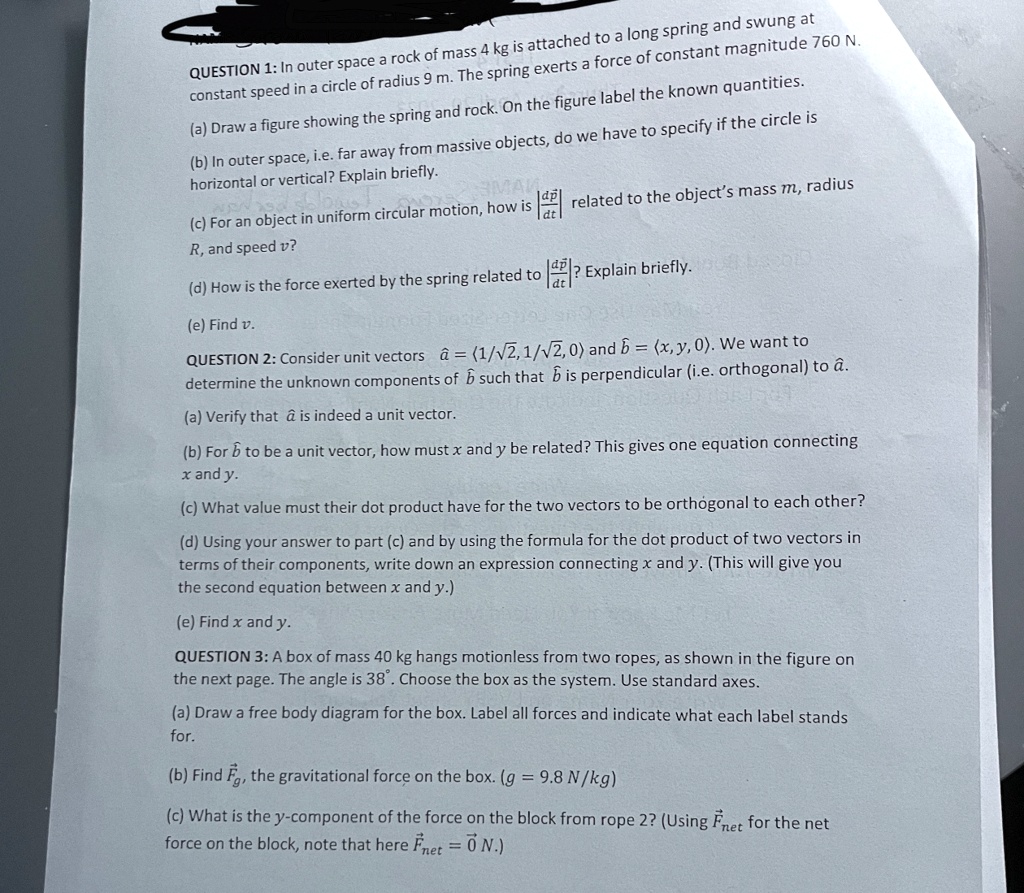
QUESTION 1: In outer space a rock of mass 4kg is attached to a long spring and swung at
constant speed in a circle of radius 9m. The spring exerts a force of constant magnitude 760N.
(a) Draw a figure showing the spring and rock. On the figure label the known quantities.
(b) In outer space, i.e. far away from massive objects, do we have to specify if the circle is
horizontal or vertical? Explain briefly.
(c) For an object in uniform circular motion, how is |(d(vec(p)))/(dt)| related to the object's mass m, radius
R, and speed v ?
(d) How is the force exerted by the spring related to |(d(vec(p)))/(dt)| ? Explain briefly.
(e) Find v.
QUESTION 2: Consider unit vectors hat(a)=(:(1)/(sqrt(2)),(1)/(sqrt(2)),0:) and hat(b)=(:x,y,0:). We want to
determine the unknown components of hat(b) such that hat(b) is perpendicular (i.e. orthogonal) to hat(a).
(a) Verify that hat(a) is indeed a unit vector.
(b) For hat(b) to be a unit vector, how must x and y be related? This gives one equation connecting
x and y.
(c) What value must their dot product have for the two vectors to be orthogonal to each other?
(d) Using your answer to part (c) and by using the formula for the dot product of two vectors in
terms of their components, write down an expression connecting x and y. (This will give you
the second equation between x and y.)
(e) Find x and y.
QUESTION 3: A box of mass 40kg hangs motionless from two ropes, as shown in the figure on
the next page. The angle is 38deg . Choose the box as the system. Use standard axes.
(a) Draw a free body diagram for the box. Label all forces and indicate what each label stands
for.
(b) Find vec(F)_(g), the gravitational force on the box. (g=9.8(N)/(k)g)
(c) What is the y-component of the force on the block from rope 2? (Using vec(F)_(net ) for the net
force on the block, note that here vec(F)_(net )=vec(0)N.)
(a) Draw a figure showing the spring and rock. On the figure label the known quantities. (b) In outer space, i.e. far away from massive objects, do we have to specify if the circle is horizontal or vertical? Explain briefly.
R,and speed v d) How is the force exerted by the spring related to [a|? Explain briefly. (e)Find v. QUESTION2:Consider unit vectorsa=1/v2,1/2,0and b=xy,0.We want to determine the unknown components of b such that b is perpendicular (i.e. orthogonal) to a. a) Verify that a is indeed a unit vector. (b) For b to be a unit vector, how must x and y be related? This gives one equation connecting xandy. (c) What value must their dot product have for the two vectors to be orthogonal to each other? (d) Using your answer to part (c and by using the formula for the dot product of two vectors in terms of their components,write down an expression connecting x and y.(This will give you the second equation between x and y.)
(eFind x and y.
QUESTION 3:A box of mass 40 kg hangs motionless from two ropes,as shown in the figure on the next page. The angle is 38.Choose the box as the system.Use standard axes. (a) Draw a free body diagram for the box.Label all forces and indicate what each label stands for.
(bFind Fg,the gravitational force on the box.g=9.8 N/kg)
(c) What is the y-component of the force on the block from rope 2? (Using Fnet for the net force on the block,note that here Fnet=0N.)