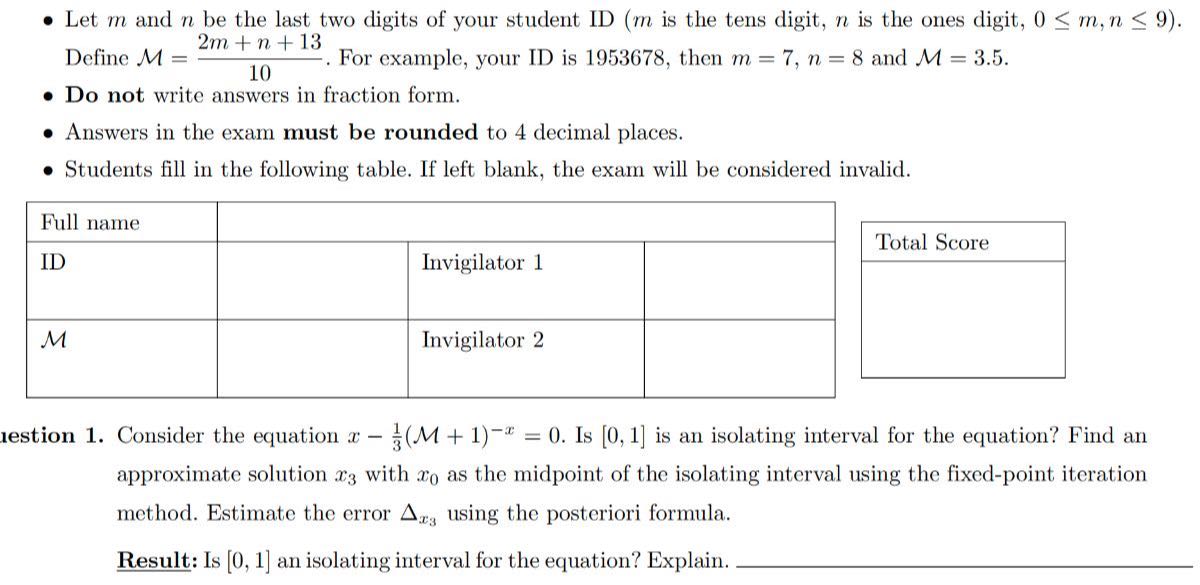
- Let \( m \) and \( n \) be the last two digits of your student ID ( \( m \) is the tens digit, \( n \) is the ones digit, \( 0 \leq m, n \leq 9 \) ). Define \( \mathcal{M}=\frac{2 m+n+13}{10} \). For example, your ID is 1953678 , then \( m=7, n=8 \) and \( \mathcal{M}=3.5 \).
- Do not write answers in fraction form.
- Answers in the exam must be rounded to 4 decimal places.
- Students fill in the following table. If left blank, the exam will be considered invalid.
\begin{tabular}{|l|l|l|l|}
\hline Full name & \multicolumn{3}{|c|}{} \\
\hline ID & & Invigilator 1 & \\
\hline \( \mathcal{M} \) & & Invigilator 2 & \\
\hline
\end{tabular}
\begin{tabular}{|l|}
\hline Total Score \\
\hline \\
\\
\\
\hline
\end{tabular}
lestion 1. Consider the equation \( x-\frac{1}{3}(\mathcal{M}+1)^{-x}=0 \). Is \( [0,1] \) is an isolating interval for the equation? Find an approximate solution \( x_{3} \) with \( x_{0} \) as the midpoint of the isolating interval using the fixed-point iteration method. Estimate the error \( \Delta_{x_{3}} \) using the posteriori formula.
Result: Is \( [0,1] \) an isolating interval for the equation? Explain.