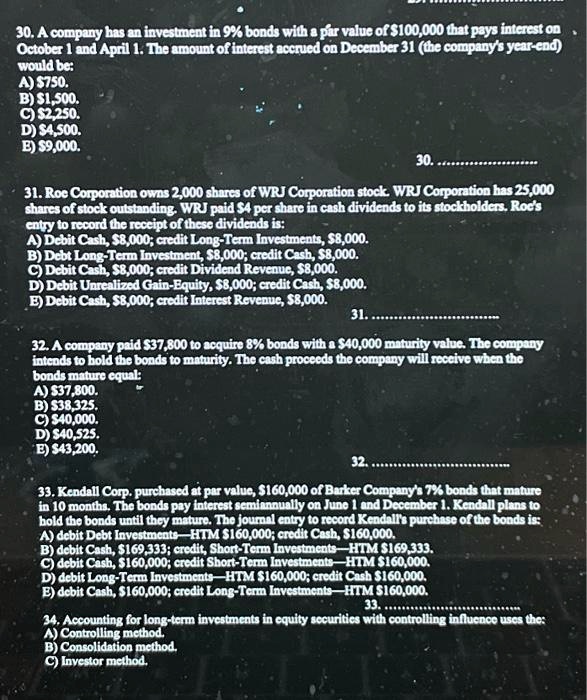
30. A company has an investment in 9% bonds with a par value of $100,000 that pays interest on October 1 and April 1. The amount of interest accrued on December 31 (the company's year-end) would be: A) $750. B) $1,500. C) $2,250. D) $4,500. E) $9,000.
31. Roc Corporation owns 2,000 shares of WRJ Corporation stock. WRJ Corporation has 25,000 shares of stock outstanding. WRJ paid $4 per share in cash dividends to its stockholders. Roc's entry to record the receipt of these dividends is: A) Debit Cash, $8,000; credit Long-Term Investments, $8,000. B) Debit Long-Term Investment, $8,000; credit Cash, $8,000. C) Debit Cash, $8,000; credit Dividend Revenue, $8,000. D) Debit Unrealized Gain-Equity, $8,000; credit Cash, $8,000. E) Debit Cash, $8,000; credit Interest Revenue, $8,000.
32. A company paid $37,800 to acquire 8% bonds with a $40,000 maturity value. The company bonds mature equal: A) $37,800. B) $38,325. C) $40,000. D) $40,525. E) $43,200.
33. Kendall Corp. purchased at par value, $160,000 of Barker Company's 7% bonds that mature in 10 months. The bonds pay interest semiannually on June 1 and December 1. Kendall plans to hold the bonds until they mature. The journal entry to record Kendall's purchase of the bonds is: A) Debit Debt Investments-HTM $160,000; credit Cash, $160,000. B) Debit Cash, $169,333; credit Short-Term Investments-HTM $169,333. C) Debit Cash, $160,000; credit Short-Term Investments-HTM $160,000. D) Debit Long-Term Investments-HTM $160,000; credit Cash $160,000. E) Debit Cash, $160,000; credit Long-Term Investments-HTM $160,000.
34. Accounting for long-term investments in equity securities with controlling influence uses the: A) Controlling method. B) Consolidation method. C) Investor method.