Instructions:
Work the cost accounting problems (Part 1 and Part 2) provided below:
Part 1: Klein Company produces three types of bird feeders: Basic, Squirrel-Proof, and Deluxe.
Currently, the company allocates overhead to products using machine hours. This year, the company produced the following:
- 1000 Basic models
- 2000 Squirrel-Proof models
- 1800 Deluxe models
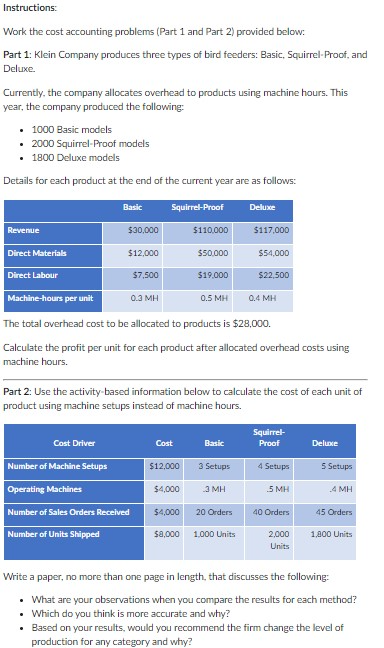
Details for each product at the end of the current year are as follows:
\begin{tabular}{|l|r|r|r|}
\hline & \multicolumn{1}{l}{ Baste } & \multicolumn{1}{c|}{ Squirr-Proof } & \multicolumn{1}{c|}{ Deluxe } \\
\hline Revenue & \( \$ 30,000 \) & \( \$ 110,000 \) & \( \$ 117,000 \) \\
\hline Direct Materials & \( \$ 12,000 \) & \( \$ 50,000 \) & \( \$ 54,000 \) \\
\hline Direct Labour & \( \$ 7,500 \) & \( \$ 19,000 \) & \( \$ 22,500 \) \\
\hline Machine-hours per unit & 0.3 MH & 0.5 MH & 0.4 MH \\
\hline
\end{tabular}
The total overhead cost to be allocated to products is \( \$ 28,000 \).
Calculate the profit per unit for each product after allocated overhead costs using machine hours.
Part 2: Use the activity-based information below to calculate the cost of each unit of product using machine setups instead of machine hours.
\begin{tabular}{|c|c|c|c|c|}
\hline Cost Driver & Coat & Basic & \begin{tabular}{l}
Squirrel \\
Proof
\end{tabular} & Deluxe \\
\hline Number of Machline Setups & \( \$ 12,000 \) & 3 Setups & 4 Setups & 5 Setups \\
\hline Operating Machines & \( \$ 4,000 \) & .3 MH & 5 MH & \( \Delta \mathrm{MH} \) \\
\hline Number of Soles Orders Reccived & \( \$ 4,000 \) & 20 Orders & 40 Orders & 45 Orders \\
\hline Number of Units Shipped & \( \$ 8,000 \) & 1.000 Units & 2,000 & 1.800 Units \\
\hline
\end{tabular}
Write a paper, no more than one page in length, that discusses the following:
- What are your observations when you compare the results for each method?
- Which do you think is more accurate and why?
- Based on your results, would you recommend the firm change the level of production for any category and why?