Ace - AI Tutor
Ask Our Educators
Textbooks
My Library
Flashcards
Scribe - AI Notes
Notes & Exams
Download App
marc jones

marc j.

Divider

Questions asked

BEST MATCH

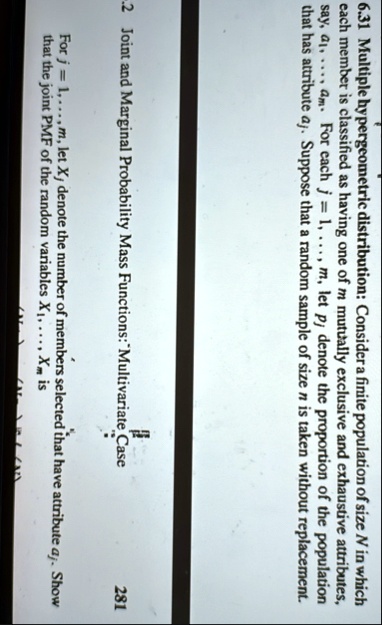
6.31 Multiple hypergeometric distribution: Consider a finite population of size N in which each member is classified as having one of m mutually exclusive and exhaustive attributes, say, $a_1, \dots, a_m$. For each $j = 1, \dots, m$, let $p_j$ denote the proportion of the population that has attribute $a_j$. Suppose that a random sample of size n is taken without replacement. .2 Joint and Marginal Probability Mass Functions: Multivariate Case For $j = 1, \dots, m$, let $X_j$ denote the number of members selected that have attribute $a_j$. Show that the joint PMF of the random variables $X_1, \dots, X_m$ is 281
View Answer
divider
BEST MATCH

Which of the following is an advantage of doing a direct listing rather than a traditional bookbuild for a company that is going public? Select all that apply. Question 2 options: Little or no lock-up of current shareholders (such as VCs). No need to reveal information (write a Prospectus) in order to go public. Lower investment banking fees. None of these are advantages.

View Answer
divider
BEST MATCH

Describe the cosets of the subgroup {1, −1,i, −i} in the quaternion group Q.

View Answer
divider
BEST MATCH

An Australian forest fire wipes out over 92% of a population of terrestrial gastropodan slugs. The slug's gene pool originally consisted of 4 alleles for dermis color CM , CS, CB and CA these occurred at frequencies of 0.3, 0.4. 0.1 and 0.2 respectively. After the fire the slug's gene pool now consists of only 2 alleles CS , and CB at frequencies of 0.2, 0.8 respectively. This type of forest fire mediated reduction in allelic variation is called

View Answer
divider
BEST MATCH

Which finding indicates the interventions provided were successful when caring for a patient with severe acute pancreatitis to improve nutritional status? Albumin 4.1 g/dL Weight unchanged 50% of meals consumed Blood urea nitrogen (BUN) 45 mg/dL

View Answer
divider
BEST MATCH

6.33 A coin is weighted so that heads is twice as likely to appear as tails. The probability that two heads occur in four tosses is: a. 0.15 b. 0.35 c. 0.45 d. 0.75 6.34 It is given that 20% of all employees leave their jobs after one year. A company hired seven new employees. The probability that nobody will leave the company after one year is: a. 0.1335 b. 0.2315 c. 0.3815 d. 0.6510 6.35 If four fair coins are tossed simultaneously, the probability that at least one head appears is: a. 0.1335 b. 0.5635 c. 0.7815 d. 0.9375 6.36 For unit normal distribution, the probability that (x > 3) is: a. 0.0013 b. 0.0178 c. 0.1807 d. 0.5402 6.37 Scores in a particular game have a normal distribution with a mean of 30 and a standard deviation of 5. Contestants must score more than 26 to qualify for the finals. The probability of being disqualified in the qualify- ing round is: a. 0.121 b. 0.212 c. 0.304 d. 0.540 6.38 The radial distance to the impact points for shells fired by a cannon is approximated by a normal Gaussian random variable with a mean of 2000 m and standard deviation of 40 m. When a target is located at 1980 m distance, the probability that shells will fall within ± 68 m of the target is: a. 0.2341 b. 0.3248 c. 0.5847 d. 0.8710

View Answer
divider
BEST MATCH

Water and sanitation concerns are of great magnitude:1.1 billion individuals,approximately 17 percent of the world's population,are without improved water and more do not have access to safe drinking water,and 2.6 billion,approximately 41 percent,are without improved sanitation. Even worse,many of the world's school children attend a school without water cognitive and developmental problems.It is further estimated that 5.000 children die every day from diseases because of lack of safe drinking water,inadequate sanitation,and poor hygiene(WSsCc.2004). Explain to the class what are the hygiene Challenges and Resources in Lower Income Countries?

View Answer
divider
BEST MATCH

A system of linear equations and a reduced matrix for the system are given.\\ $\begin{cases} x - y + z = 3\\ 3x + 2z = 7\\ x - 4y + 2z = 5 \end{cases}$ $\begin{bmatrix} 1 & 0 & \frac{2}{3} &\\\ 0 & 1 & -\frac{1}{3} \\\ 0 & 0 & 0 \end{bmatrix}$ $\begin{bmatrix} 7\\\ 3\\\ -2\\\ 0 \end{bmatrix}$\\(a) Use the reduced matrix to find the general solution of the system, if one exists. (If there is no solution, enter NO SOLUTION. If there are infinitely many solutions, express your answers in terms of z as in Example 3.)\\$(x, y, z) = ($\\(b) If multiple solutions exist, find two specific solutions. (Enter your answers as a comma-separated list of ordered triples. If there is no solution, enter NO SOLUTION.)\\$(x, y, z) = $

View Answer
divider
BEST MATCH

Problem 5 At the instant shown, the tower crane rotates about the z axis with an angular velocity $\omega_1$ = 0.27 rad/s, which is increasing at 0.6 rad/s². The boom OA rotates downward with an angular velocity $\omega_2$ = 0.4 rad/s, which is increasing at 0.7 rad/s². (Figure 1) Part A Determine the velocity of point A located at the end of the boom at this instant. Enter the x, y, and z components of the velocity separated by commas. $v_A$ = -2.5, 1.35, -2 ft/s Submit Previous Answers Request Answer Incorrect; Try Again; 7 attempts remaining Figure Part B Determine the acceleration of point A located at the end of the boom at this instant. Enter the x, y, and z components of the acceleration separated by commas. $a_A$ = ft/s² Submit Request Answer Provide Feedback

View Answer
divider
BEST MATCH

Master theorem: \begin{equation*} T(n) = \begin{cases} c & \text{if } n < d\\ aT(n/b) + f(n) & \text{if } n \ge d \end{cases} \end{equation*} 1. if $f(n)$ is $O(n^{\log_b a - \epsilon})$, then $T(n)$ is $\Theta(n^{\log_b a})$ 2. if $f(n)$ is $\Theta(n^{\log_b a} \log^k n)$, then $T(n)$ is $\Theta(n^{\log_b a} \log^{k+1} n)$ 3. if $f(n)$ is $\Omega(n^{\log_b a + \epsilon})$, then $T(n)$ is $\Theta(f(n))$, provided $af(n/b) \le \delta f(n)$ for some $\delta < 1$. Which of the three cases above applies to an algorithm, the running time of which is described using the following recurrence relation: T(n) = 2 T(n/2) + \log^2 n Type 1 for case 1, and so on. For case 2, also specify a k value after a space, e.g., "2 2" Type N/A if the Master theorem is not applicable to the recurrence relation Answer:

View Answer
divider