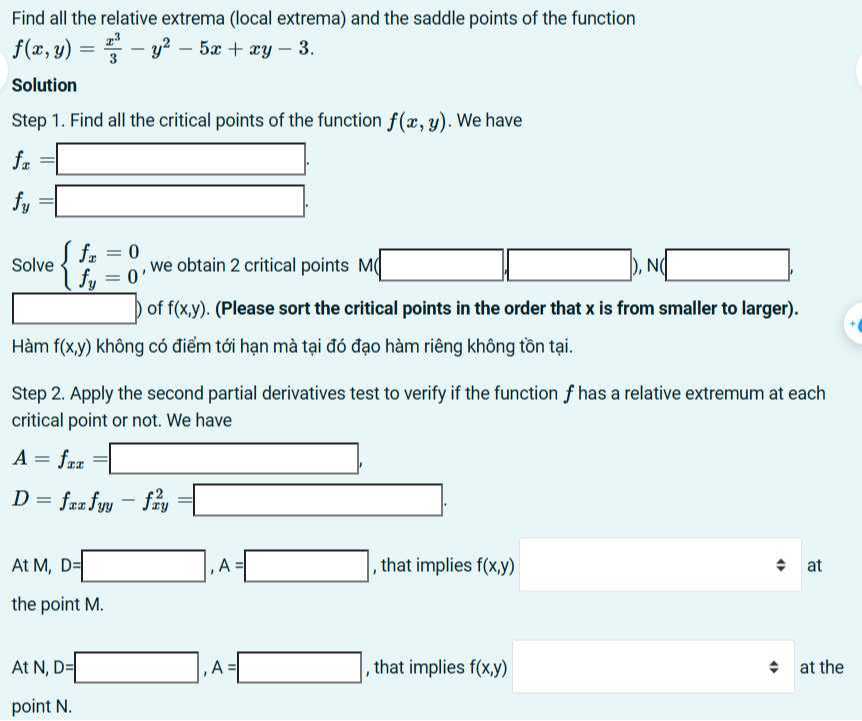
Find all the relative extrema (local extrema) and the saddle points of the function
\[
f(x, y)=\frac{x^{3}}{3}-y^{2}-5 x+x y-3
\]
Solution
Step 1. Find all the critical points of the function \( f(x, y) \). We have
\[
\begin{array}{l}
f_{x}=\square \\
f_{y}=\square
\end{array}
\]
Solve \( \left\{\begin{array}{l}f_{x}=0 \\ f_{y}=0\end{array}\right. \), we obtain 2 critical points \( M / \) \( \square \)
\( \square \) ), \( N( \) \( \square \) ,
\( \qquad \) of \( f(x, y) \). (Please sort the critical points in the order that \( x \) is from smaller to larger). Hàm \( \mathrm{f}(\mathrm{x}, \mathrm{y}) \) không có ?i?m t?i h?n mà t?i ?ó ??o hàm riêng không t?n t?i.
Step 2. Apply the second partial derivatives test to verify if the function \( f \) has a relative extremum at each critical point or not. We have
\[
\begin{array}{l}
A=f_{x x}=\square \\
D=f_{x x} f_{y y}-f_{x y}^{2}=\square
\end{array}
\]
At \( M, D=\square \) \( \square \) , \( A= \) \( \square \) , that implies \( f(x, y) \) \( \square \) at the point \( M \).
At \( N, D= \) \( \square \) , \( A= \) \( \square \) , that implies \( f(x, y) \) \( \square \) at the point N .