Ace - AI Tutor
Ask Our Educators
Textbooks
My Library
Flashcards
Scribe - AI Notes
Notes & Exams
Download App
marcos delgado

marcos d.

Divider

Questions asked

BEST MATCH

The National Health Insurance model is characterized by Question 2 options: having both health care providers and health care payers be private entities with the government regulating medical services and fees. It is financed primarily by employers and employees. having health care provided by and financed by the government through tax payments. Medical services are a public service, like the fire department. This system may also have private doctors as well who collect fees from the government. having patients purchase insurance out-of-pocket having health care providers as private entities, but the payer as a government entity. In this model, the government collects monthly premiums and pays medical bills.

View Answer
divider
BEST MATCH

A charged capacitor and an inductor are connected in series. At time t = 0, the current is zero but the capacitor is charged. If T is the period of the resulting LC oscillations, the next time after t = 0 that the voltage across the inductor is a positive maximum is a. 2T b. T/2 c. T/4 d. T

View Answer
divider
BEST MATCH

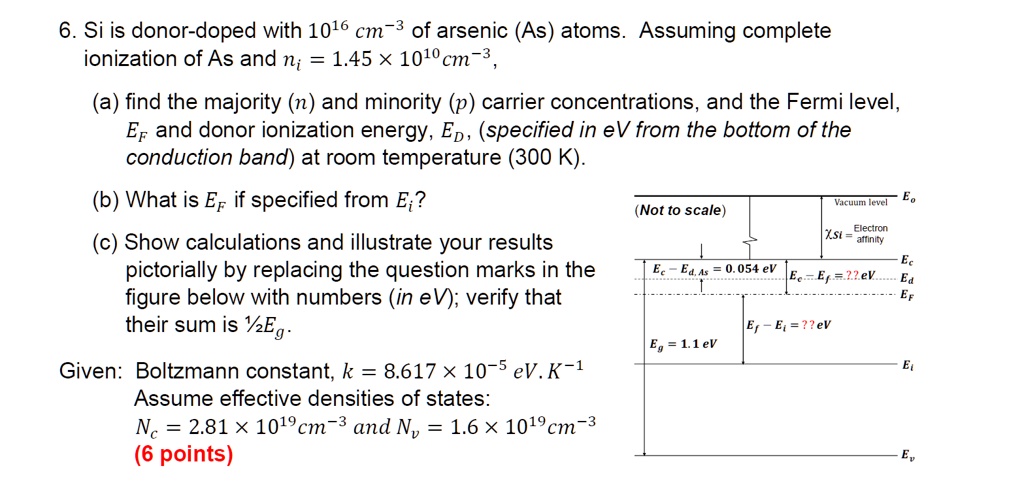
6. Si is donor-doped with $10^{16} cm^{-3}$ of arsenic (As) atoms. Assuming complete ionization of As and $n_i = 1.45 \times 10^{10} cm^{-3}$, (a) find the majority (n) and minority (p) carrier concentrations, and the Fermi level, $E_F$ and donor ionization energy, $E_D$, (specified in eV from the bottom of the conduction band) at room temperature (300 K). (b) What is $E_F$ if specified from $E_i$? (c) Show calculations and illustrate your results pictorially by replacing the question marks in the figure below with numbers (in eV); verify that their sum is $1/2E_g$. Given: Boltzmann constant, $k = 8.617 \times 10^{-5} eV. K^{-1}$ Assume effective densities of states: $N_c = 2.81 \times 10^{19} cm^{-3}$ and $N_v = 1.6 \times 10^{19} cm^{-3}$ (6 points) (Not to scale) Vacuum level $E_0$ Electron $\chi_{Si} =$ affinity $E_c$ $E_c - E_{d,As} = 0.054 eV$ $E_c - E_f = ?? eV$ $E_d$ $E_F$ $E_f - E_i = ?? eV$ $E_g = 1.1 eV$ $E_i$ $E_v$
View Answer
divider
BEST MATCH

a block is at the top of a frictionless ramp that is 2.0 m long and 0.10 m high

View Answer
divider
BEST MATCH

In developing insurance rates, which one of the following is generally used as a starting point to estimate future losses? Select one: A. Insureds' financial stability B. Exposure analysis based on physical inspections C. Current individual loss trends D. Past loss experience

View Answer
divider
BEST MATCH

Use the limit laws to evaluate \( \lim_{x \to -1} (4 - 7x)\sqrt{5x + 8} \).

View Answer
divider
BEST MATCH

2 a c d e 3 6

View Answer
divider
BEST MATCH

You just inherited a trust fund worth $188,398.62 from your long-lost uncle. The trust fund will pay you regular monthly payments for 40.0 years (480.0 months). If the annual interest rate on the trust fund is 12% (monthly periodic rate is 1%), then how much money will you receive each month? Round intermediate steps to 6 decimal places.

View Answer
divider
BEST MATCH

1. Draw a picture of a moving source and the waves surrounding it according to what you observed in this experiment. How does the spacing of the wavefronts in front of the source compare to those behind it? (Note: To draw a picture, you can use MS Paint or any other drawing software you may have. You can save the image file as a jpg or a bmp and then insert it into the Word document.) 2. Imagine a small observer is positioned in front of the cork in your picture above. As the cork approaches, the observer measures the wavelength of the waves passing by. How does this wavelength compare to that measured from behind the source? 3. Imagine that this same observer measures the frequency of the waves instead of wavelength. How does the frequency measured in front of the source appear to the observer compared to the frequency measured from behind? 4. How do these results help explain why a car's engine sounds different as the car approaches you compared with after it passes?

View Answer
divider
BEST MATCH

11. Which of the following is NOT an example of inverse variation? a. $c = \frac{k}{d}$ b. $a = \frac{k}{b}$ c. $k = \frac{e}{f}$ d. $z = \frac{k}{x}$

View Answer
divider