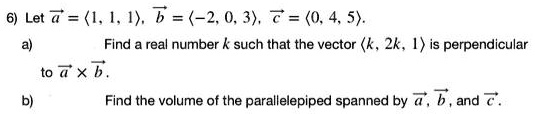
6) Let \(\vec{a} = (1, 1, 1)\), \(\vec{b} = (-2, 0, 3)\), \(\vec{c} = (0, 4, 5)\).
a) Find a real number \(k\) such that the vector \((k, 2k, 1)\) is perpendicular
to \(\vec{a} \times \vec{b}\).
b) Find the volume of the parallelepiped spanned by \(\vec{a}\), \(\vec{b}\), and \(\vec{c}\).