According to a study, the mean cost of bariatric (weight loss) surgery is $21,500. You think this information is incorrect. You randomly select 25 bariatric surgery patients and find that the mean cost for their surgeries is $20,695. From past studies, the population standard deviation is known to be $2250 and the population is normally distributed. Is there enough evidence to support your claim at $\alpha = 0.05$? Use a P-value. (Adapted from The American Journal of Managed Care)
Because $\sigma$ is known ($\sigma = $2250), the sample is random, and the population is normally distributed, you can use the z-test. The claim is \"the mean is different from $21,500.\" So, the null and alternative hypotheses are
$H_0: \mu = 21500$
and
$H_a: \mu \neq 21500$. (Claim)
The level of significance is $\alpha = 0.05$. The standardized test statistic is
$z = \frac{\bar{x} - \mu}{\sigma / \sqrt{n}}$
$= \frac{20695 - \boxed{}}{2250/\sqrt{\boxed{}}}$
$\approx -1.79$.
Because $\sigma$ is known and the population is normally distributed, use the z-test.
Assume $\mu = 21500$.
Round to two decimal places.
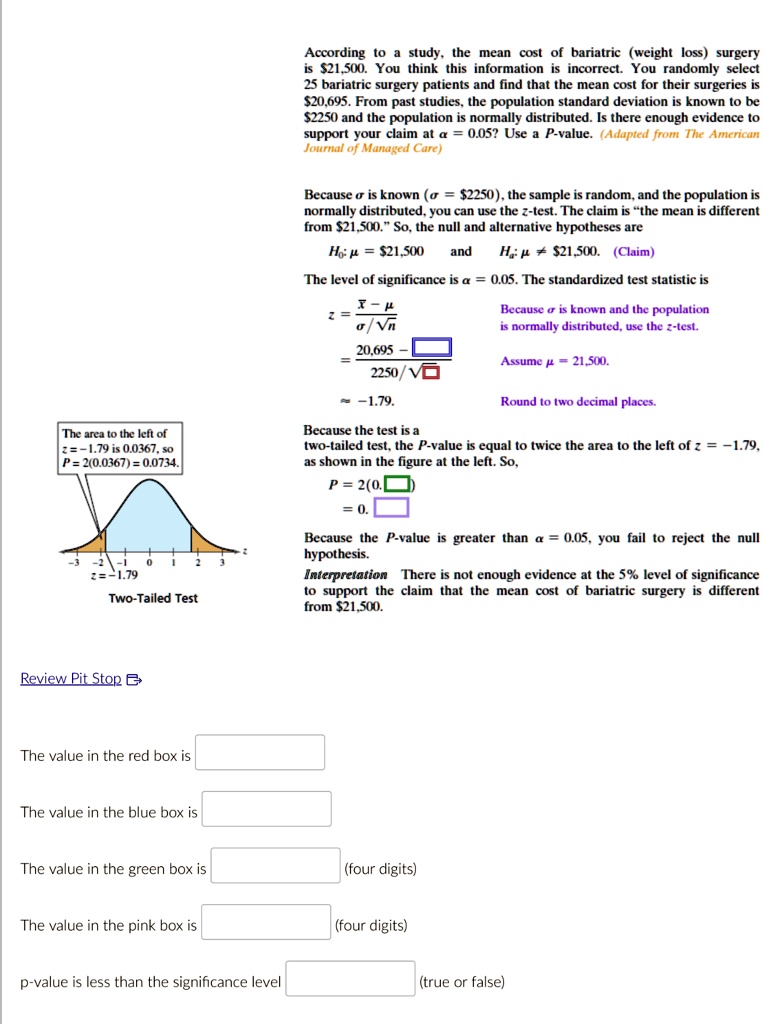
The area to the left of
$z = -1.79$ is 0.0367, so
$P = 2(0.0367) = 0.0734$.
$z = -1.79$
Two-Tailed Test
Because the test is a two-tailed test, the P-value is equal to twice the area to the left of $z = -1.79$, as shown in the figure at the left. So,
$P = 2(\boxed{0.\boxed{}}) = \boxed{0.\boxed{}}$
Because the P-value is greater than $\alpha = 0.05$, you fail to reject the null hypothesis.
Interpretation There is not enough evidence at the 5% level of significance to support the claim that the mean cost of bariatric surgery is different from $21,500.
Review Pit Stop
The value in the red box is
The value in the blue box is
The value in the green box is
(four digits)
The value in the pink box is
(four digits)
p-value is less than the significance level
(true or false)