Ace - AI Tutor
Ask Our Educators
Textbooks
My Library
Flashcards
Scribe - AI Notes
Notes & Exams
Download App
marcus parker

marcus p.

Divider

Questions asked

BEST MATCH

1. Local and Average Convection Coefficients A fluid at a temperature of $T_{\infty} = 360 K$ flows past the upper surface of a solid plate at $T_s = 370 K$ to cool it, as shown below. The surface being cooled has a total length of $L = 2 m$ and a width (into the page) of $B = 1 m$. The local convection coefficient is of the form. $$h = Cx^{-1/2},$$ where $C$ is an unknown constant. The convective heat transfer from the upstream half of the plate is $q = 150 W$. a) Use the local convection coefficient to find the average convective heat transfer coefficient of the upstream half of the plate, $\bar{h}_1$. Leave your answer in terms of $C$. b) Use the heat transfer rate from the upstream half of the plate to find the average convective heat transfer coefficient $\bar{h}_1$. c) Solve for the constant $C$. d) Find the average convective heat transfer coefficient for the whole plate.

View Answer
divider
BEST MATCH

2. You will be given: a stock of 5X Bradford reagent (0.05% Coomassie G-250, 24% methanol, 42.5% phosphoric acid) a stock of 0.5 mg/mL BSA protein (might be a different concentration, check label) MilliQ water Calculate the amount of Bradford reagent, BSA, and water to add to each cuvette so that the final volume in each is 1.5 ml. DO THIS BEFORE CLASS. Record your calculations in your notebook. Hint 1: To determine how much Bradford reagent to add, do a C1V1 calculation. The final desired concentration of a solution is always 1x; this does not need to be stated. Hint 2: To determine how much BSA, do a separate C1V1 calculation. Make sure to convert stock concentration of BSA to the same units as the final desired concentration.

View Answer
divider
BEST MATCH

Use provided measured absorbance values of Escherichia coli and Bacillus subtilis at 28°C and 37°C to answer questions 1-4 on Microbial Growth (posted on HuskyCT) (2 points). 1. Bacterial growth rate must be determine from the log phase of the growth curve. Why? 2. List the remaining phases of the growth curve and briefly explain what is occurring in each with respect to the bacterial cells. 3. Does temperature affect the growth rate of the bacteria that was tested? If so, which temperature is optimal for growing E. coli? B. subtilis? Is there a difference in growth between the two organisms? If so, why? 4. What is the generation time for E. coli? B. subtilis?

View Answer
divider
BEST MATCH

Which duct drains lymph from the right upper limb and right side of the head, neck, and thorax? Left lymphatic duct Right lymphatic duct Thoracic duct Abdominal duct

View Answer
divider
BEST MATCH

:The embryonic part of the placenta is formed by the Decidua basalis a ? Decidua capsularis b ? Chorion frontosum c ? Decidua parietalis d ?

View Answer
divider
BEST MATCH

- SQL Week 2 Question 100-013 - You want the big ones. Make a list of all the ID, the name, the Creature SubType, and weight and height. You only want those whose weight is greater than or equal to 150 or those whose height is greater than or equal to 65. Sort your results alphabetically by Name and then ascending by idLitCharacter.

View Answer
divider
BEST MATCH

Sun Dec 3 d(y) = 6(4)^y @myopenmath.com Select an answer Select an answer Question Help: Video Message instructor Post to forum Submit Question Question 3 0/4 pts 3 99 Evaluating and Solving an Linear and Exponential Applications Identify the information given to you in the application problem below. Use that information to answer the questions that follow. Assume you can invest $3000 at 3.1% Simple Interest or 2.1% Compound Interest (Annual). The equation for Simple Interest is modeled by: A = P + Prt. Compound Interest is modeled by A = P(1 + r)^t. The corresponding equations for these two types of interest are given below. S(t) = 3000 + 93t C(t) = 3000(1.021)^t Complete the table for each function. Round your answers to two decimal places as needed. t 1 5 10 S(t) C(t) Question Help: Video Message instructor Post to forum Submit Question

View Answer
divider
BEST MATCH

Ots) Sketch the graph of an example of a function $f$ that satisfies all the given conditions: $f(-2) = \text{undefined}$ $f(0) = 2$ $f(3) = 0$ $\lim_{x \to -2} f(x) = 1$ $\lim_{x \to 0^-} f(x) = 2$ $\lim_{x \to 0^+} f(x) = \infty$

View Answer
divider
BEST MATCH

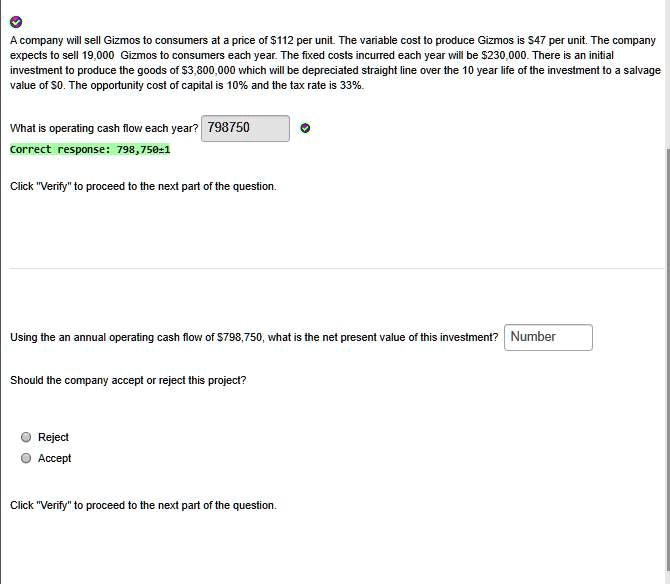
I know how to do the first part. I do not know how to get the NPV without the discount rate. Please help :) A company will sell Gizmos to consumers at a price of $112 per unit. The variable cost to produce Gizmos is $47 per unit. The company expects to sell 19,000 Gizmos to consumers each year. The fixed costs incurred each year will be $230,000. There is an initial investment to produce the goods of $3,800,000 which will be depreciated straight line over the 10-year life of the investment to a salvage value of $0. The opportunity cost of capital is 10% and the tax rate is 33%. What is the operating cash flow each year? $798,750 Correct response: $798,750 Click Verify to proceed to the next part of the question. Using an annual operating cash flow of $798,750, what is the net present value of this investment? Number Should the company accept or reject this project? Reject Accept Click "Verify" to proceed to the next part of the question.
View Answer
divider
BEST MATCH

Text: 6. Let wt = tan(1e^xt) = t - 2 + t + 3wt and yt = 2 - t + 2t - t/2 + 3wt a. Plot(t) b. Plot y(t). Hint: First use the properties of the delta function to represent yt in simplest form. c. Plot the signal t = -d7 d. Plot the signal yt = y+)dr.

View Answer
divider