Ace - AI Tutor
Ask Our Educators
Textbooks
My Library
Flashcards
Scribe - AI Notes
Notes & Exams
Download App
marcus torres

marcus t.

Divider

Questions asked

BEST MATCH

It is likely that mammals grew fur because We were nocturnal Were diurnal Ate different food We needed to blend in

View Answer
divider
BEST MATCH

What is GDP using the table shown? Consumption Investment Transfer payments Government Purchases Exports Imports Net foreign factor income 6,050 5,570 5,600 6,320 In trillions of dollars 3,600 800 750 1,000 650 450 -30

View Answer
divider
BEST MATCH

a. H$_3$C$-$N$-$CH$_3$ The expected C$-$N$-$C angle in this molecule is The expected hybridization at the central nitrogen (C$-$N$-$C) is $sp^3$

View Answer
divider
BEST MATCH

Profit maximization always leads to long-term value creation for shareholders. True False * 1 point

View Answer
divider
BEST MATCH

Q3) Assuming the Earth's orbit is circular with radius R, the distance it travels in one year would be the circumference = 2\pi R. Calculate the Earth's orbital speed (in km/s) using that along with the numbers in the previous paragraph. Q4) Any force that bends the path of an object along a circular arc is called a "centripetal force", for the Earth's orbit it is the gravitational pull of the Sun that provides the centripetal force. If a centripetal force is causing a mass m to move along a circular arc of radius R at a speed v, the exact strength of that force must be equal to $mv^2/R$. For the Earth's orbit, that means: $GMm/R^2 = mv^2/R$ Use this formula to solve for the Earth's speed v. Then put in values, M is the Sun's mass, m is the Earth's mass (but note it cancels out in the equation), and R is the Earth-Sun distance. You should convert R into meters before substituting it into the equation, you'll get v in m/s, finish the problem by converting that to km/s. Show all your work, you should get the same answer as you got for Q3.

View Answer
divider
BEST MATCH

Answer the following questions in grammatically correct sentences 1. There is no difference between change in demand and change in quantity demanded. Do you agree or disagree? Explain. 2. What is the difference between normal good and inferior good? 3. Discuss briefly complementary goods and supplementary goods. 4. What are the advantages and disadvantages of the price system? 5. Predict what will happen to either supply or demand in the following situations: a. Several new companies enter the home computer industry. b. Consumers suddenly decide large cars are unfashionable. c. The U.S. surgeon general issues a report that tomatoes prevent colds. d. A new type of robot is invented that will pick peaches.

View Answer
divider
BEST MATCH

8. In Europe, which grain is wasted the most? a. Corn b. Wheat c. Rice 9. For every pound of shrimp caught, up to ____ pounds of other species are discarded. a. 2 b. 4 c. 6 d. 20 10. Regarding Renewable Energy, the Yoplait factory in TN saves $____ dollars per year through anaerobic digestion. a. 100,000 b. 500,000 c. 1.5 million d. 2.4 million 11. A head of lettuce takes ~____ to decompose in a landfill. a. 1 month b. 6 months c. 1 year d. 25 years

View Answer
divider
BEST MATCH

Cranial nerve abducts the eye. Only motor. [Choose] Cranial nerve helps you sense odors. Only sensory. [Choose] Cranial nerve allows you to roll your tongue. [Choose] Only motor. Cranial nerve allow you to move 4 of your 6 eye muscles as well as control iris [Choose] diameter. Motor. Cranial nerve helps you shrug your [Choose] shoulders and mover your head. Motor. Cranial nerve allows you to form sight. [Choose] Sensory. Cranial nerve allow you to swallow and [Choose] throw up as well as taste different sensations. Motor and Sensory. Cranial nerve allos you to from tears, make funny expressions, blink and taste the food that can be sweet and salty (popcorn and chocolate - yum!). Motor and Sensory [Choose] Cranial nerve that moves the eye down and medial. Motor [Choose]

View Answer
divider
BEST MATCH

The circuit in Figure 2 has an input-output relationship in time domain as given below: \frac{v_c(t)}{R} + C \frac{dv_c(t)}{dt} = \frac{v_s(t)}{R} $v_s(t)$ +$ $C$ +$ $v_c(t)$ Figure 2: RC Circuit $R = \alpha \Omega$ $C = a F$ $v_s(t) = 2au(t) V$ $v_c(0^-) = v_c(0) = v_c(0^+) = a V$ a) (10 points) By using the above values, obtain $V_c(s)$ (on your paper). b) (10 points) By using the $V_c(s)$ expression you found in step a, find the $v_c(t)$ expression in MATLAB. c) (10 points) By using the $v_c(t)$ expression you found in step b, find the $V_c(s)$ expression in MATLAB.

View Answer
divider
BEST MATCH

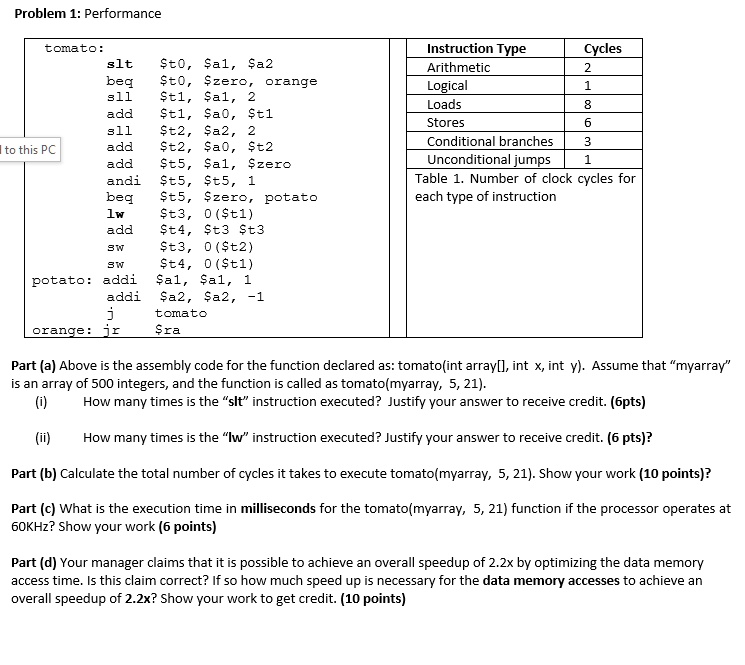
Problem 1: Performance tomato: slt $t0, $al, $a2 beq $t0, $zero, orange sll $t1, $al, 2 add $tl, $a0, $tl sll $t2, $a2, 2 add $t2, $a0, $t2 add $t5, $al, $zero andi $t5, $t5, 1 beq $t5, $zero, lw $t3, 0($t1) add $t4, $t3, $t3 lw $t3, 0($t2) lw $t4, 0($t1) potato: addi $al, $al, 1 addi $a2, $a2, -1 j tomato orange: 7r Sra Instruction Type Cycles Arithmetic 2 Logical 1 Loads 8 Stores 6 Conditional branches 3 Unconditional jumps 1 Table 1. Number of clock cycles for each type of instruction Part (a) Above is the assembly code for the function declared as: tomato(int array[], int x, int y). Assume that myarray is an array of 500 integers, and the function is called as tomato(myarray, 5, 21). (i) How many times is the slt instruction executed? Justify your answer to receive credit. (6pts) (ii) How many times is the lw instruction executed? Justify your answer to receive credit. (6 pts) (iii) How many clock cycles are required to execute the entire function tomato(myarray, 5, 21)? Show your work (6 points) Part (d) Your manager claims that it is possible to achieve an overall speedup of 2.2x by optimizing the data memory access time. Is this claim correct? If so, how much speedup is necessary for the data memory accesses to achieve an overall speedup of 2.2x? Show your work to get credit. (10 points)
View Answer
divider