4.
a) Briefly describe advantages that state space techniques have over classical control
techniques.
[4 marks]
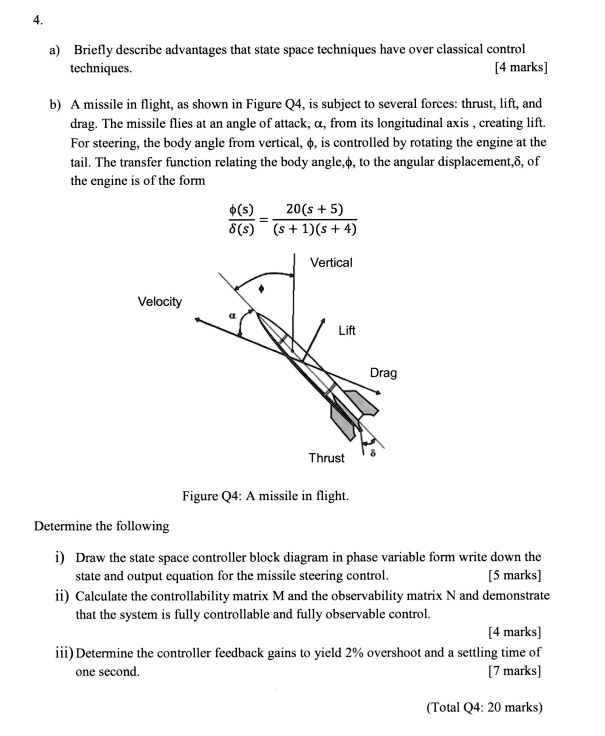
b) A missile in flight, as shown in Figure Q4, is subject to several forces: thrust, lift, and
drag. The missile flies at an angle of attack, $\alpha$, from its longitudinal axis, creating lift.
For steering, the body angle from vertical, $\phi$, is controlled by rotating the engine at the
tail. The transfer function relating the body angle, $\phi$, to the angular displacement, $\delta$, of
the engine is of the form
$\frac{\phi(s)}{\delta(s)} = \frac{20(s + 5)}{(s + 1)(s + 4)}$
Vertical
Velocity
$\alpha$
Lift
Drag
Thrust
Figure Q4: A missile in flight.
Determine the following
i) Draw the state space controller block diagram in phase variable form write down the
state and output equation for the missile steering control.
[5 marks]
ii) Calculate the controllability matrix M and the observability matrix N and demonstrate
that the system is fully controllable and fully observable control.
[4 marks]
iii) Determine the controller feedback gains to yield 2% overshoot and a settling time of
one second.
[7 marks]
(Total Q4: 20 marks)