Now we know that the voltage-current behavior of an inductor of
inductance L is:
$$v_L = L \frac{di_L(t)}{dt}$$
It turns out that, just like with resistors, various combinations of
inductors are terminal-equivalent to a single inductor with an
nductance determined from the inductances of the parts of the
combination. For each of the following circuits give the
inductance of an equivalent inductor, as seen from the exposed
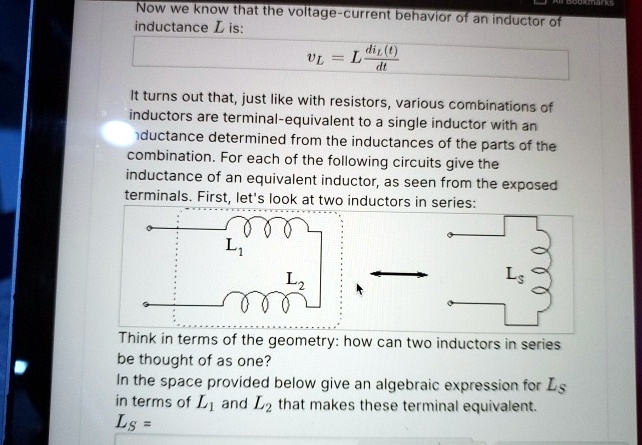
terminals. First, let's look at two inductors in series:
L1
L2
Ls
Think in terms of the geometry: how can two inductors in series
be thought of as one?
In the space provided below give an algebraic expression for Ls
in terms of L₁ and L₂ that makes these terminal equivalent.
Ls =