5.51
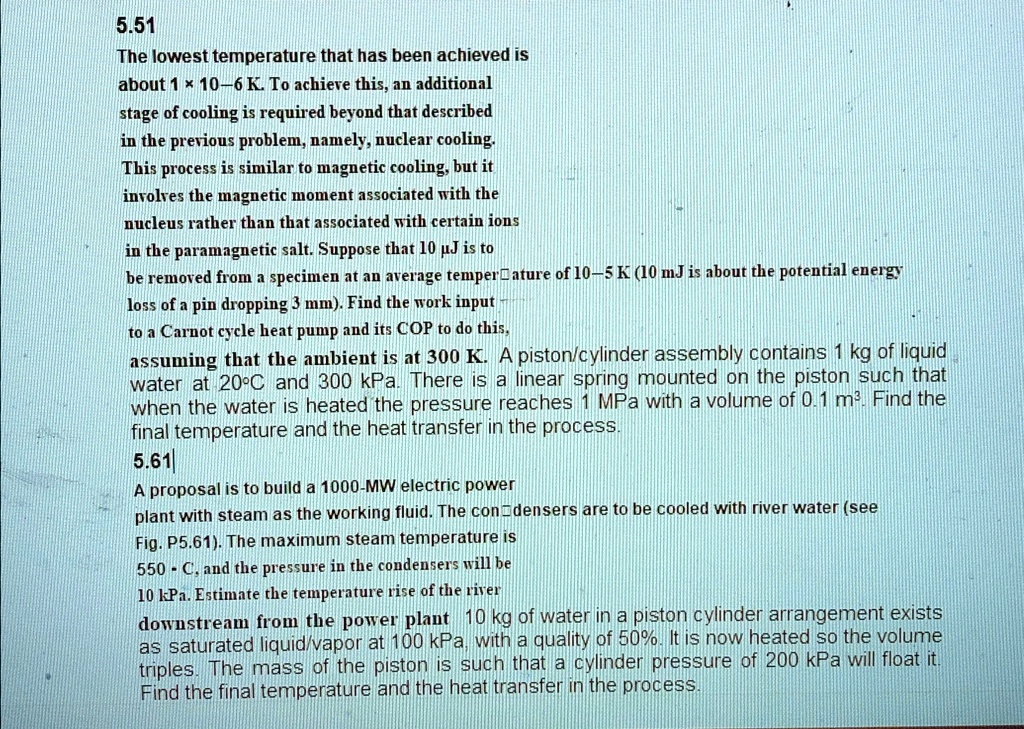
The lowest temperature that has been achieved is about 1 x 10^-6 K. To achieve this, an additional stage of cooling is required beyond that described in the previous problem, namely, nuclear cooling. This process is similar to magnetic cooling, but it involves the magnetic moment associated with the nucleus rather than that associated with certain ions in the paramagnetic salt. Suppose that 10 μJ is to be removed from a specimen at an average temperature of 105 K (10 mJ is about the potential energy loss of a pin dropping 3 mm). Find the work input to a Carnot cycle heat pump and its COP to do this, assuming that the ambient is at 300 K. A piston/cylinder assembly contains 1 kg of liquid water at 20°C and 300 kPa. There is a linear spring mounted on the piston such that when the water is heated, the pressure reaches 1 MPa with a volume of 0.1 m^3. Find the final temperature and the heat transfer in the process.
5.61
A proposal is to build a 1000-MW electric power plant with steam as the working fluid. The condensers are to be cooled with river water (see Fig. P5.61). The maximum steam temperature is 550°C, and the pressure in the condensers will be 10 kPa. Estimate the temperature rise of the river downstream from the power plant. 10 kg of water in a piston-cylinder arrangement exists as saturated liquid/vapor at 100 kPa, with a quality of 50%. It is now heated so the volume triples. The mass of the piston is such that a cylinder pressure of 200 kPa will float it. Find the final temperature and the heat transfer in the process.