1
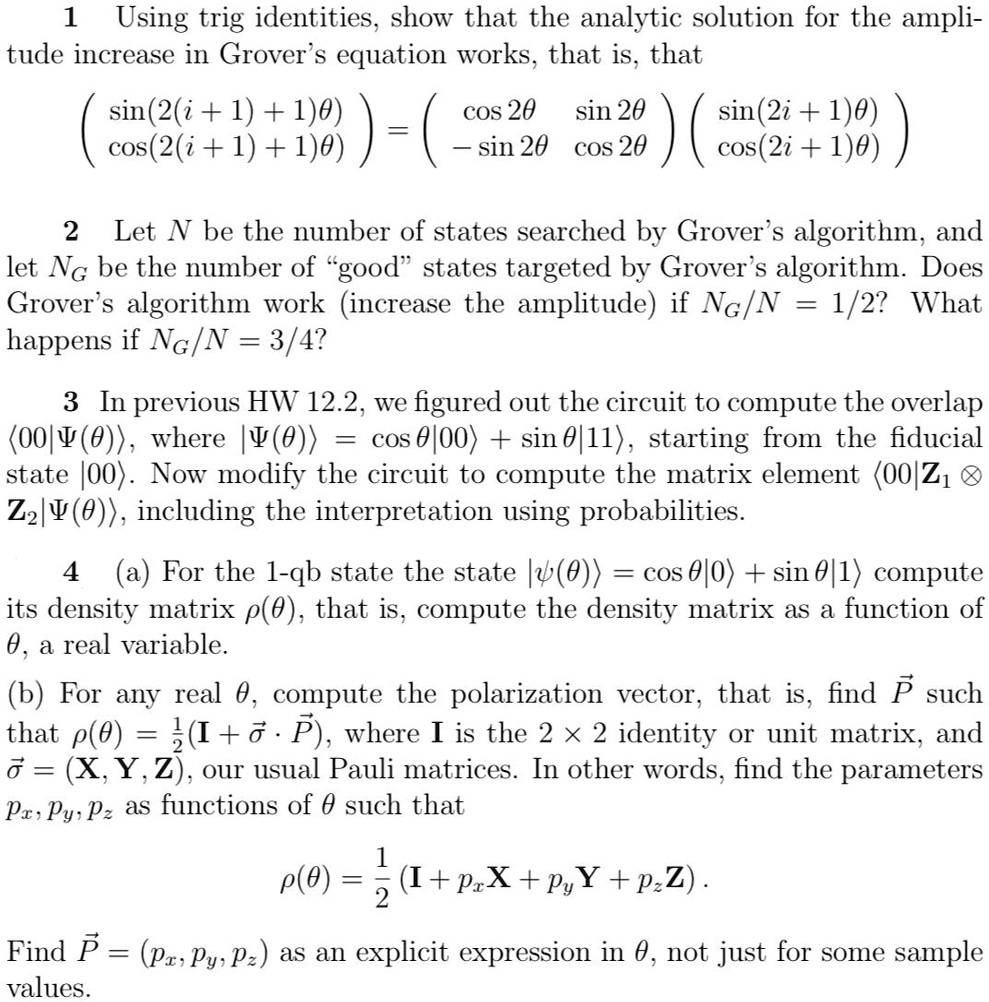
Using trig identities, show that the analytic solution for the ampli-
tude increase in Grover's equation works, that is, that
\begin{pmatrix} \sin(2(i + 1) + 1)\theta) \\ \cos(2(i + 1) + 1)\theta) \end{pmatrix} = \begin{pmatrix} \cos 2\theta & \sin 2\theta \\ -\sin 2\theta & \cos 2\theta \end{pmatrix} \begin{pmatrix} \sin(2i + 1)\theta) \\ \cos(2i + 1)\theta) \end{pmatrix}
2 Let N be the number of states searched by Grover's algorithm, and
let N_G be the number of \"good\" states targeted by Grover's algorithm. Does
Grover's algorithm work (increase the amplitude) if N_G/N = 1/2? What
happens if N_G/N = 3/4?
3 In previous HW 12.2, we figured out the circuit to compute the overlap
(00|\Psi(\theta)), where |\Psi(\theta)) = \cos \theta|00) + \sin \theta|11), starting from the fiducial
state |00). Now modify the circuit to compute the matrix element (00|Z_1 \otimes
Z_2|\Psi(\theta)), including the interpretation using probabilities.
4 (a) For the 1-qb state the state |\psi(\theta)) = \cos \theta|0) + \sin \theta|1) compute
its density matrix \rho(\theta), that is, compute the density matrix as a function of
\theta, a real variable.
(b) For any real \theta, compute the polarization vector, that is, find \vec{P} such
that \rho(\theta) = \frac{1}{2}(I + \vec{\sigma} \cdot \vec{P}), where I is the 2 \times 2 identity or unit matrix, and
\vec{\sigma} = (X, Y, Z), our usual Pauli matrices. In other words, find the parameters
P_x, P_y, P_z as functions of \theta such that
\rho(\theta) = \frac{1}{2}(I + P_x X + P_y Y + P_z Z).
Find \vec{P} = (P_x, P_y, P_z) as an explicit expression in \theta, not just for some sample
values.