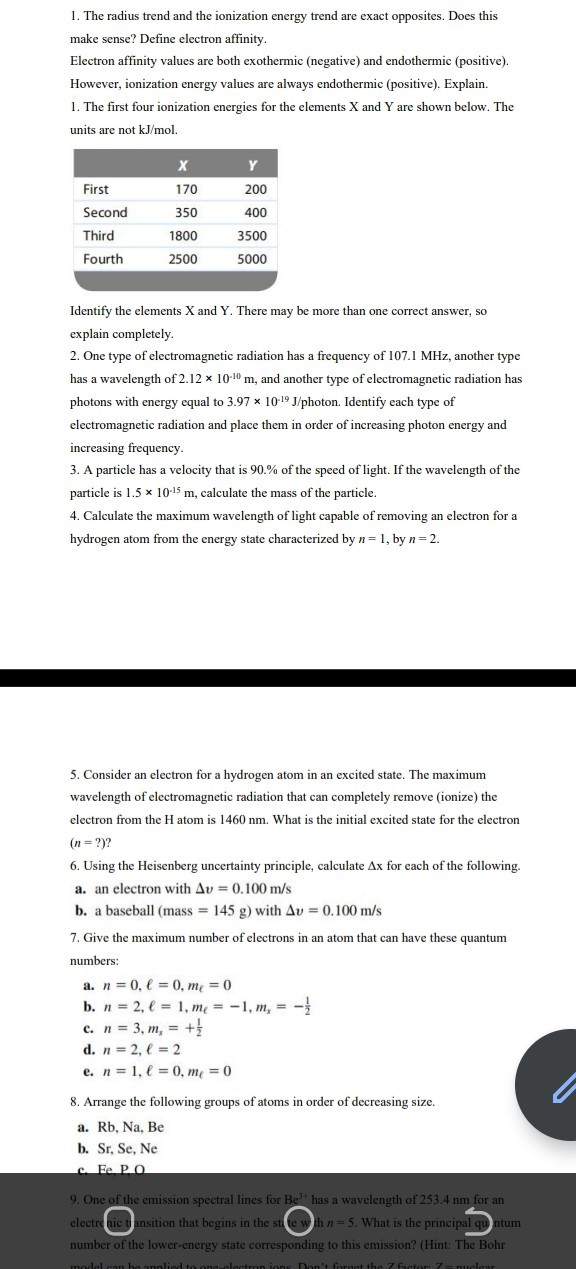
1. The radius trend and the ionization energy trend are exact opposites. Does this make sense? Define electron affinity.
Electron affinity values are both exothermic (negative) and endothermic (positive). However, ionization energy values are always endothermic (positive). Explain.
1. The first four ionization energies for the elements \( \mathrm{X} \) and \( \mathrm{Y} \) are shown below. The units are not \( \mathrm{kJ} / \mathrm{mol} \).
\begin{tabular}{|lcr|}
\hline & \( \boldsymbol{X} \) & \( \boldsymbol{Y} \) \\
\hline First & 170 & 200 \\
\hline Second & 350 & 400 \\
\hline Third & 1800 & 3500 \\
\hline Fourth & 2500 & 5000 \\
\hline
\end{tabular}
Identify the elements \( \mathrm{X} \) and \( \mathrm{Y} \). There may be more than one correct answer, so explain completely.
2. One type of electromagnetic radiation has a frequency of 107.1 MHz, another type has a wavelength of \( 2.12 \times 10^{-10} \mathrm{~m} \), and another type of electromagnetic radiation has photons with energy equal to \( 3.97 \times 10^{-19} \mathrm{~J} / \) photon. Identify each type of electromagnetic radiation and place them in order of increasing photon energy and increasing frequency.
3. A particle has a velocity that is \( 90 . \% \) of the speed of light. If the wavelength of the particle is \( 1.5 \times 10^{-15} \mathrm{~m} \), calculate the mass of the particle.
4. Calculate the maximum wavelength of light capable of removing an electron for a hydrogen atom from the energy state characterized by \( n=1 \), by \( n=2 \).
5. Consider an electron for a hydrogen atom in an excited state. The maximum wavelength of electromagnetic radiation that can completely remove (ionize) the electron from the \( \mathrm{H} \) atom is \( 1460 \mathrm{~nm} \). What is the initial excited state for the electron \( (n=?) \) ?
6. Using the Heisenberg uncertainty principle, calculate \( \Delta x \) for each of the following.
a. an electron with \( \Delta v=0.100 \mathrm{~m} / \mathrm{s} \)
b. a baseball (mass \( =145 \mathrm{~g} \) ) with \( \Delta v=0.100 \mathrm{~m} / \mathrm{s} \)
7. Give the maximum number of electrons in an atom that can have these quantum numbers:
a. \( n=0, \ell=0, m_{\ell}=0 \)
b. \( n=2, \ell=1, m_{\ell}=-1, m_{s}=-\frac{1}{2} \)
c. \( n=3, m_{s}=+\frac{1}{2} \)
d. \( n=2, \ell=2 \)
e. \( n=1, \ell=0, m_{\ell}=0 \)
8. Arrange the following groups of atoms in order of decreasing size.
a. \( \mathrm{Rb}, \mathrm{Na}, \mathrm{Be} \)
b. \( \mathrm{Sr}, \mathrm{Se}, \mathrm{Ne} \)
9. One of the emission spectral lines for \( \mathrm{Be}^{3+} \) has a wavelength of \( 253.4 \mathrm{~nm} \) for an
number of the lower-energy state corresponding to this emission? (Hint: The Bohr