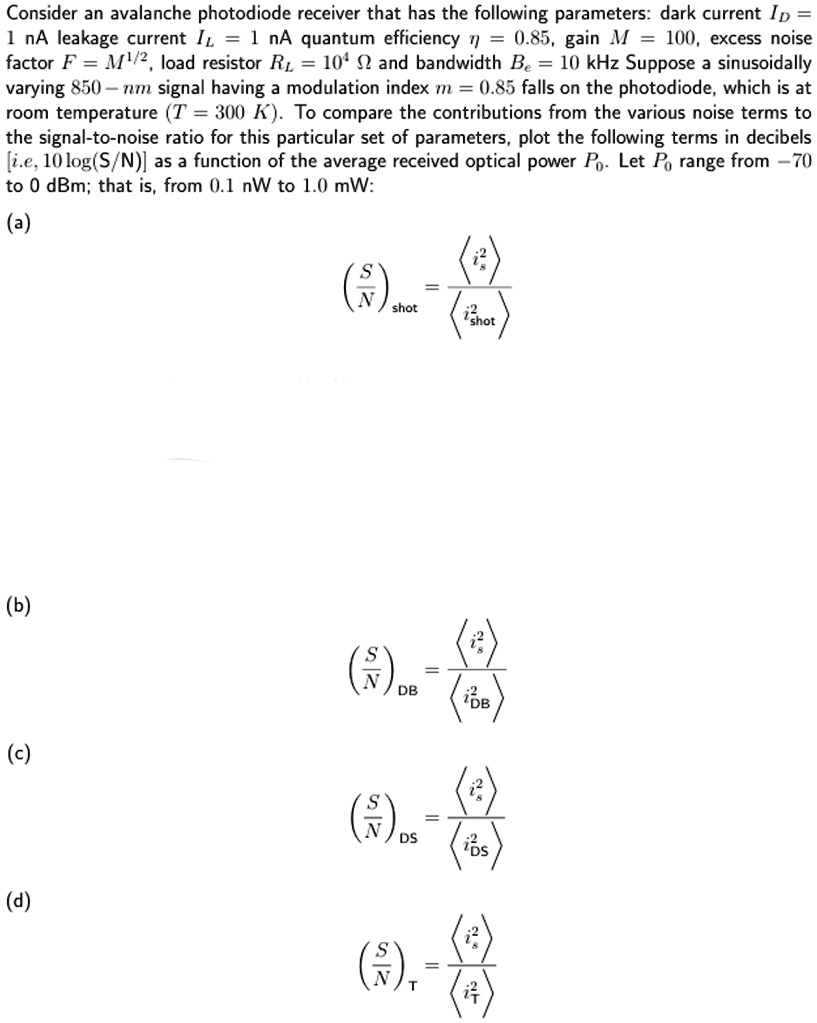
Consider an avalanche photodiode receiver that has the following parameters: dark current $I_D = 1 nA$ leakage current $I_L = 1 nA$ quantum efficiency $\eta = 0.85$, gain $M = 100$, excess noise factor $F = M^{1/2}$, load resistor $R_L = 10^4 \Omega$ and bandwidth $B_e = 10 kHz$ Suppose a sinusoidally varying $850 nm$ signal having a modulation index $m = 0.85$ falls on the photodiode, which is at room temperature ($T = 300 K$). To compare the contributions from the various noise terms to the signal-to-noise ratio for this particular set of parameters, plot the following terms in decibels [i.e, $10 \log(S/N)$] as a function of the average received optical power $P_o$. Let $P_o$ range from $-70$ to $0 dBm$; that is, from $0.1 nW$ to $1.0 mW$:
(a)
$\left(\frac{S}{N}\right)_{shot} = \frac{\langle i_s^2 \rangle}{\langle i_{shot}^2 \rangle}$
(b)
$\left(\frac{S}{N}\right)_{DB} = \frac{\langle i_s^2 \rangle}{\langle i_{DB}^2 \rangle}$
(c)
$\left(\frac{S}{N}\right)_{DS} = \frac{\langle i_s^2 \rangle}{\langle i_{DS}^2 \rangle}$
(d)
$\left(\frac{S}{N}\right)_T = \frac{\langle i_s^2 \rangle}{\langle i_T^2 \rangle}$