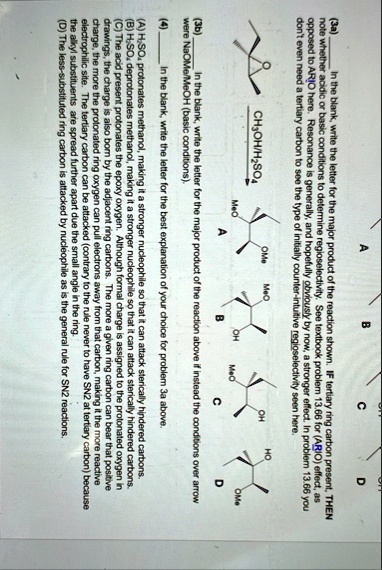
(3a) In the blank, write the letter for the major product of the reaction shown. IF tertiary ring carbon present, THEN note whether acidic or basic conditions to determine regioselectivity. See textbook problem 13.66 for ARO effect, as opposed to ARO here. Resonance is generally and hopefully obviously by now, a stronger effect. In problem 13.66 you don't even need a tertiary carbon to see the type of initially counter-intuitive regioselectivity seen here.
CH3OH/H2SO4
MeO
A
MeO
B
OH
MeO
C
OH
HO
D
OMe
(3b) In the blank, write the letter for the major product of the reaction above if instead the conditions over arrow were NaOMe/MeOH (basic conditions).
(4) In the blank, write the letter for the best explanation of your choice for problem 3a above.
(A) H2SO4 protonates methanol, making it a stronger nucleophile so that it can attack sterically hindered carbons.
(B) H2SO4 deprotonates methanol, making it a stronger nucleophile so that it can attack sterically hindered carbons.
(C) The acid present protonates the epoxy oxygen. Although formal charge is assigned to the protonated oxygen in drawings, the charge is also born by the adjacent ring carbons. The more a given ring carbon can bear that positive charge, the more the protonated ring oxygen can pull electrons away from that carbon, making it the more reactive electrophilic site. The tertiary carbon can be attacked (contrary to the rule never to have SN2 at tertiary carbon) because the alkyl substituents are spread further apart due the small angle in the ring.
(D) The less-substituted ring carbon is attacked by nucleophile as is the general rule for SN2 reactions.