Ace - AI Tutor
Ask Our Educators
Textbooks
My Library
Flashcards
Scribe - AI Notes
Notes & Exams
Download App
maria neal

maria n.

Divider

Questions asked

BEST MATCH

The current assets of Vaughn Company are $294200. The current liabilities are $147100. The current ratio expressed as a proportion is Ο 0.50:1. $147100 \div $294200. Ο 2.00:1. Ο 200%.

View Answer
divider
BEST MATCH

According to the evolutionary psychology view, women showing an adaptive preference for choosing long-term mates who can provide for their offspring is an expression of Multiple Choice natural selection. social learning. environmental design. behaviorism.

View Answer
divider
BEST MATCH

A general partner in a limited partnership is. -Multiple Choice not personally liable for the partnership's debts and liabilities personally liable for the partnership's debts and liabilities only to the extent of their capital contribution to the firm personally liable for all the partnership's debts and liabilities personally liable for the partnership's debts and liabilities only to the extent of their relative net worth compared to the net worth of the other general partners

View Answer
divider
BEST MATCH

1. In each of the following parts, list the cosets of the subgroup $H$ in the group $G$. For each coset, list the elements in the coset. (a) $H = \langle 4 \rangle$, $G = \mathbb{Z}_{12}$ (b) $H = \{(0,0), (0,1)\}$, $G = \mathbb{Z}_3 \times \mathbb{Z}_2$ (c) $H = \{e, (23)\}$, $G = S_3$

View Answer
divider
BEST MATCH

Text: New Ways to Use Web-Based Applications As technology continues to advance, its applications are expanding. Companies are now exploring innovative ways to empower their employees to handle different aspects of their work without the need for a dedicated staff member. One such approach is through the utilization of web-based self-service applications. In this discussion, we will explore novel ways in which employees can leverage web-based self-service applications within their respective companies, resulting in significant time and cost savings. We will not only describe these applications and their functionalities but also highlight how they contribute to the overall efficiency and financial well-being of the organization. Additionally, we will address any drawbacks associated with this process from the employee's perspective.

View Answer
divider
BEST MATCH

We have the following training dataset: X (exponential) Y (normal) Z (categorical) L (target class) 0.022 0.470 Up No 0.533 1.044 Up Down No Yes 0.413 -0.587 0.181 -1.461 Down No 0.365 -1.170 Down Yes 2.568 -0.547 Up Up No Yes 0.081 -0.678 0.463 0.313 Up No 0.511 2.080 Up No 0.303 -0.760 Down Yes In this dataset, X, Y, and Z are the features and the classes are shown in column L. X is exponentially distributed, Y is normally distributed, and Z is a categorical variable. (a) By calculating the probabilities, train a Naive Bayes classifier. (15 points) (b) Using your classifier from part (a), predict the class of the following input: (5 points) X = 0.07, Y = 0, and Z = Down

View Answer
divider
BEST MATCH

Duration is 15 minutes. sorve both froblems. Open material. Calculators are allowed. Laptops computers are disallowed. Cell phones must be turned off and stowed away. Staple this form to your solution. Problem 1(50%) Child A and Child B are riding a seesaw at opposite ends as shown schematically in the Figure. Child A is initially at rest touching the ground. A parent lifts Child A upwards with a sustained angular acceleration of $a = k\theta^2$ [rad/s²], where $\theta$ is the angle shown in the diagram, as measured from the vertical fulcrum to the seesaw, increasing in a counterclockwise direction, while k is a constant. At the instant when the seesaw is parallel to the ground, Child B is moving towards the ground with a speed of 1 ft/s. The fulcrum is located 3 ft 3 ft above the ground, and the total length of the seesaw is 10 feet. a) Calculate the constant k. (15%) b) Calculate the velocity and its magnitude of Child B at the instant when his end hits the ground. (15%) c) At the same instant, calculate Child B's acceleration and its magnitude. (15%) d) Establish the scheme (or an expression) to find the total time from when Child B starts moving to when he hits the ground. While you need to provide the scheme/expression, you do not need to evaluate it. (5%) Problem 2 (50%) Seesaw B start Parallel to ground 2 $a = k\theta^2$ 1 ft/s $\theta$ Y 3 ft B A

View Answer
divider
BEST MATCH

A 24,000 kg freight car is coasting at 0.500 m/s with negligible friction under a hopper that dumps 100,000 kg of scrap metal into it. (a) What is the final velocity (in m/s) of the loaded freight car? (Enter the magnitude.) m/s (b) How much kinetic energy (in J) is lost?

View Answer
divider
BEST MATCH

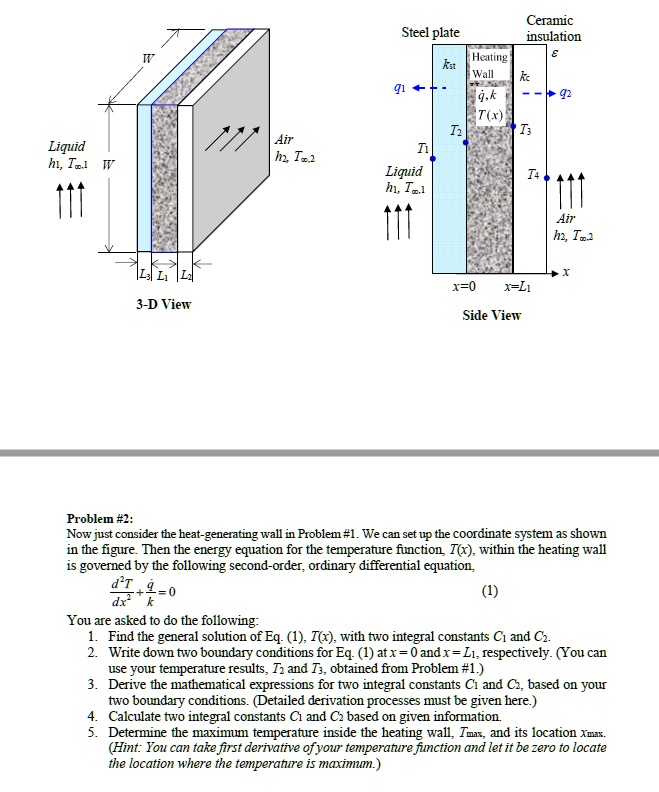
W Ceramic Steel plate insulation Heating ? kst Wall kc q1 ?,k q2 T(x) T2 T3 Liquid h1, T?,1 W 111 Air h2, T?,2 Ti Liquid h1, T?,1 111 L1 3-D View T4 Air h2, T?,2 x x=0 x=L1 Side View Problem #2: Now just consider the heat-generating wall in Problem #1. We can set up the coordinate system as shown in the figure. Then the energy equation for the temperature function, T(x), within the heating wall is governed by the following second-order, ordinary differential equation, $\frac{d^2T}{dx^2} + \frac{\dot{q}}{k} = 0$ You are asked to do the following: (1) 1. Find the general solution of Eq. (1), T(x), with two integral constants C? and C?. 2. Write down two boundary conditions for Eq. (1) at x = 0 and x = L?, respectively. (You can use your temperature results, T? and T?, obtained from Problem #1.) 3. Derive the mathematical expressions for two integral constants C? and C?, based on your two boundary conditions. (Detailed derivation processes must be given here.) 4. Calculate two integral constants C? and C? based on given information. 5. Determine the maximum temperature inside the heating wall, Tmax, and its location xmax. (Hint: You can take first derivative of your temperature function and let it be zero to locate the location where the temperature is maximum.)
View Answer
divider
BEST MATCH

A mixture of real gases is composed of 40 percent methane (CH4), 23 percent propane (C3H8), and 37 percent ethane (C2H6) by weight. This mixture is compressed from 0.93 MPa and 20 °C to 9.2 MPa in an isentropic, steady-flow compressor. Calculate the required work for this compression process per unit mass of the mixture by using generalized charts. Assume constant specific heats at 300 K.

View Answer
divider