This should be done by Minitab, please show the steps on how to do it with Minitab.
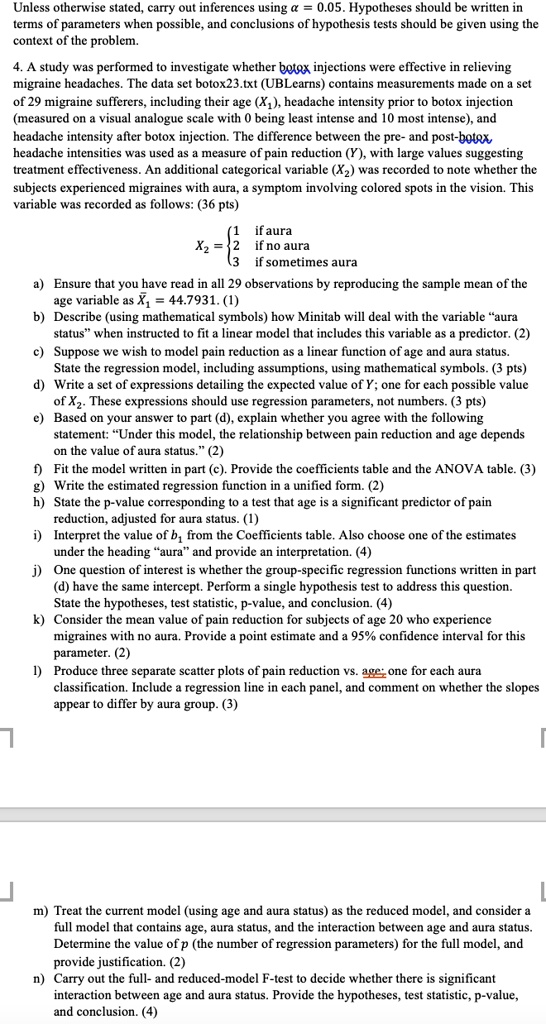
Unless otherwise stated, carry out inferences using α=0.05. Hypotheses should be written in terms of parameters when possible, and conclusions of hypothesis tests should be given using the context of the problem.
4. A study was performed to investigate whether Botox injections were effective in relieving migraine headaches. The data set botox23.txt (UBLearns) contains measurements made on a set of 29 migraine sufferers, including their age (X), headache intensity prior to Botox injection (measured on a visual analogue scale with 0 being least intense and 10 most intense), and headache intensity after Botox injection. The difference between the pre- and post-Botox headache intensities was used as a measure of pain reduction (Y), with large values suggesting treatment effectiveness. An additional categorical variable (X2) was recorded to note whether the subjects experienced migraines with aura, a symptom involving colored spots in the vision. This variable was recorded as follows: (36 pts)
(1 if aura X={2 if no aura (3 if sometimes aura
a) Ensure that you have read in all 29 observations by reproducing the sample mean of the age variable as X=44.7931.1) b) Describe (using mathematical symbols) how Minitab will deal with the variable aura status when instructed to fit a linear model that includes this variable as a predictor. (2) c) Suppose we wish to model pain reduction as a linear function of age and aura status. State the regression model, including assumptions, using mathematical symbols. (3 pts) (p Write a set of expressions detailing the expected value of Y; one for each possible value of X,. These expressions should use regression parameters, not numbers. (3 pts) e) Based on your answer to part (d), explain whether you agree with the following statement: Under this model, the relationship between pain reduction and age depends on the value of aura status. (2) f) Fit the model written in part (c). Provide the coefficients table and the ANOVA table. (3) g) Write the estimated regression function in a unified form. (2) h) reduction, adjusted for aura status. (1) i) Interpret the value of b, from the Coefficients table. Also choose one of the estimates under the heading aura and provide an interpretation. (4) J) One question of interest is whether the group-specific regression functions written in part (d) have the same intercept. Perform a single hypothesis test to address this question. State the hypotheses, test statistic, p-value, and conclusion. (4) k) Consider the mean value of pain reduction for subjects of age 20 who experience migraines with no aura. Provide a point estimate and a 95% confidence interval for this parameter. (2) 1) Produce three separate scatter plots of pain reduction vs. ageone for each aura classification. Include a regression line in each panel, and comment on whether the slopes appear to differ by aura group. (3)
m) Treat the current model (using age and aura status) as the reduced model, and consider a full model that contains age, aura status, and the interaction between age and aura status. Determine the value of p (the number of regression parameters) for the full model, and provide justification. (2) n) Carry out the full- and reduced-model F-test to decide whether there is significant interaction between age and aura status. Provide the hypotheses, test statistic, p-value, and conclusion. (4)