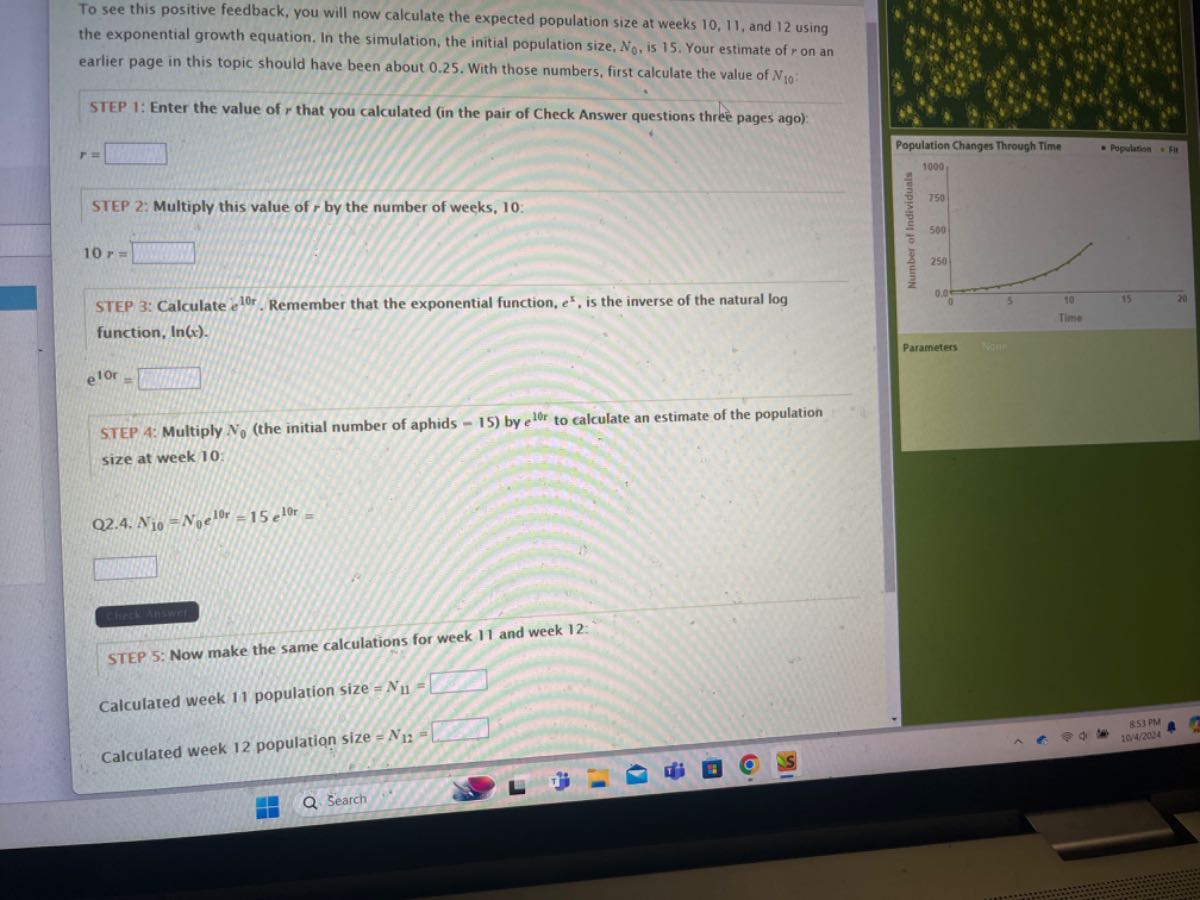
To see this positive feedback, you will now calculate the expected population size at weeks 10,11 , and 12 using the exponential growth equation. In the simulation, the initial population size, \( N_{0} \), is 15. Your estimate of \( r \) on an earlier page in this topic should have been about 0.25 . With those numbers, first calculate the value of \( N_{10} \) :
STEP 1: Enter the value of \( r \) that you calculated (in the pair of Check Answer questions three pages ago):
\[
r=\square
\]
STEP 2: Multiply this value of \( r \) by the number of weeks, 10 :
\( 10 r= \) \( \square \)
STEP 3: Calculate \( e^{10 r} \). Remember that the exponential function, \( e^{x} \), is the inverse of the natural log function, \( \ln (x) \).
\[
e^{10 r}=
\]
\( \square \)
STEP 4 : Multiply \( N_{0} \) (the initial number of aphids -15 ) by \( e^{10 r} \) to calculate an estimate of the population size at week 10 :
Q2.4. \( N_{10}=N_{0} e^{10 r}=15 e^{10 \mathrm{r}}= \)
\( \square \) STEP 5: Now make the same calculations for week 11 and week 12: STEP 5: Now make the same calculations for week 11 a
\( \square \)
Calculated week 12 population size \( =N_{12}= \) \( \square \)