Ace - AI Tutor
Ask Our Educators
Textbooks
My Library
Flashcards
Scribe - AI Notes
Notes & Exams
Download App
mariano leon

mariano l.

Divider

Questions asked

BEST MATCH

Find the equivalent resistance between points A and B in the drawing. 2.00 $\Omega$ 6.00 $\Omega$ 1.00 $\Omega$ A 4.00 $\Omega$ 3.00 $\Omega$ 2.00 $\Omega$ B 3.00 $\Omega$

View Answer
divider
BEST MATCH

1. [20 pts.] We want to simplify Prandtl's lifting-line theory by assuming that a wing with elliptical loading, peak circulation $\Gamma_0$, and span $b$ can be represented by a single horseshoe vortex with constant circulation $\Gamma_0$ and span $b'$. (This is a crude but simple model that is useful for quick computations of interference effects.) (a) [3 pts] Determine the span $b'$ of the simplified system such that the lift on the two wings is the same. (b) [3 pts] Calculate the induced drag for the simplified system assuming that the downwash at the wing root can be used for the entire wing. What is the percentage error in the induced drag compared to the value for the elliptic wing using lifting-line theory? (c) [2 pts] Let us consider the idea of modeling a wing-tail combination by using a single horseshoe vortex with constant circulation to model each of the two lifting surfaces. For this baseline case, the tail bound vortex is located a length $\ell = 3b'/8$ downstream of the wing bound vortex, where $b'$ is the wingspan as shown in the image. Determine the induced drag for the tail, $D_{i,t}$, as a function of $\Gamma_w$, $\Gamma_t$, $b'$, $V_\infty$ and $\rho_\infty$ (note that your answer might be in terms of some but not all these parameters). Simplify your final result. Assume the downwash can be approximated by the downwash at the center of the tail's bound vortex and that the span of the tail is $b'/4$. i.e.: the downwash on the tail should be evaluated at the point $(\ell = 3b'/8, 0, 0)$. (d) [2 pts] Again, for this baseline case, determine the induced drag for the wing, $D_{i,w}$, as a function of $\Gamma_w$, $\Gamma_t$, $b'$, $V_\infty$ and $\rho_\infty$ (note that your answer might be in terms of some but not all of these parameters). Simplify your final result. Assume the downwash can be approximated by the downwash at the center of the wing's bound vortex i.e.: the downwash on the wing should be evaluated at the point $(0, 0, 0)$. (e) [10 pts.] Use the simple theory to calculate the percentage change in the induced drag for the wing and the tail as a function of the separation distance $\ell$, as shown above when compared to the baseline case values found in part (c) and (d). Write a computer program (using MATLAB/python/C++ etc. is fine) to compute and plot the percentage change in induced drag for the wing and tail as a function of the nondimensional streamwise distance $1 \le \ell/b' \le 10$. Discuss how the induced drag changes with the separation distance and whether the trends seem to make physical sense. (Hint: use the Biot-Savart law given in the class notes to compute the downwash velocity at the wing and tail root but be sure to account for the contributions of all the pieces of the vortex systems, keeping in mind that a straight-line vortex does not induce any motion on itself. Assume $\Gamma_w = 1$ and $\Gamma_t = 0.1$.
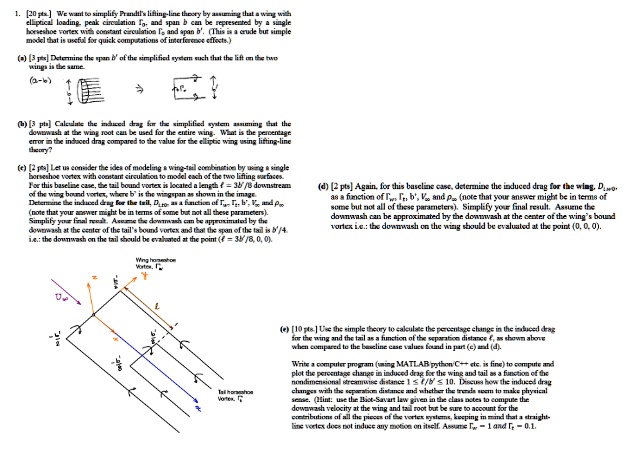
View Answer
divider
BEST MATCH

True or false? Taxes collected at the federal level but spent at the state level are counted as state spending.

View Answer
divider
BEST MATCH

English is the official language of 1) United States of America 2) United Kingdom 3) Australia

View Answer
divider
BEST MATCH

Extra Credit - Fall Semester 2023 Question 67 If $f(x) = (e^{3x} + \sin(2x))^4$, then $f'(x) =$ A. $4(3e^{3x} + 2\cos(2x))^3$ B. $4(e^{3x} + \sin(2x))^3(3e^{3x} + \cos(2x))$ C. $4(e^{3x} + \sin(2x))^3(3e^{3x} + 2\sin(2x))$ D. $4(e^{3x} + \sin(2x))^3(3e^{3x} + 2\cos(2x))$

View Answer
divider
BEST MATCH

dur dur ug dur um dur 1aP dur Uy 12ur 20u aur +gr+ at ar ae az par rar ar 72 +2 0 az2 due due ugdug on'n aue 11P one 20ur a2ue +ur +1z +g+v te ar r ae az prae r2 r292 r z2 duz duz ugduz duz 1aP duz) 1uz2uz at ar az a Though many terms in these equations appear similar to the Cartesian form, there are a number of r2r2 not space-independent; they vary depending on where you are in space (@z does not vary in space, which is why many of the z-related terms do not change from Cartesian to cylindrical coordinates. er=egand Deg a5 Show that the unit vectors e and e are both functions of ,such that - a0 -er. r2 a92 az2 vV2(u) for cylindrical coordinates, taking into account your result from (a), and show that the expression given above is correct (extra terms and all)

View Answer
divider
BEST MATCH

A bank which has assets of $85 billion and a net worth of $10 billion must have: Multiple Choice liabilities of $75 billion. excess reserves of $10 billion. liabilities of $10 billion. excess reserves of $75 billion.

View Answer
divider
BEST MATCH

4. Consider a Go-Back-N protocol with a sender window size of N and a sequence number range of 1024. Suppose that at time t the next packet that the receiver is expecting has a sequence number of k. Assume that the medium does not re-order messages. Answer the following: (a) Assume the receiver has received packet k-1 and has ACKed that and all other preceding packets and the ACKs have been received at the sender. The sender's window is [ , ]. Justify your answer in terms of k and N. (a) Suppose that none of the ACKs have been received at the sender, the sender's window is [ , ] (b) What are all possible values of the ACK field in all possible messages currently propagating back to the sender at time t?

View Answer
divider
BEST MATCH

Marcellus would like to calculate the return on equity for the Orion Group. Last year, it recorded a net income of $560 million on 12 million common shares. The company paid $12 million in preferred dividends and reported common equity of $925 million. Orion's balance sheet reported current assets of $365 million, total assets of $3,875 million and current liabilities of $305 million. What is the return on assets ratio for Orion Group? Oa) 9.42% b) 14.45% c) 14.14% d) 23.87%

View Answer
divider
BEST MATCH

Question #3 (6 marks): In this question, we will create and prove a new convergence test. Does the series Ln(t^m) diverge? n=1. (c) Prove the following convergence test: n=∑(dn)^2 + ∑(qn)^2 + ∑(oobos)^2. (d) Apply our brand new test to the series 2+2+5.6m 3n+n+8 in order to see if it converges or diverges.

View Answer
divider