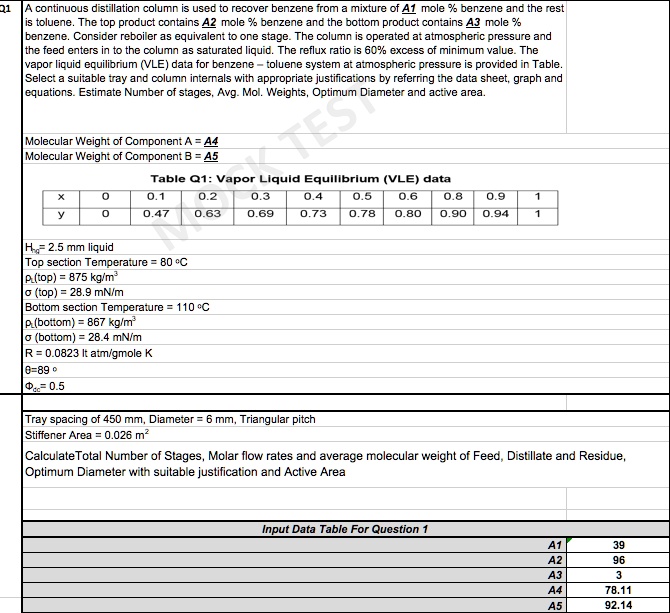
A continuous distillation column is used to recover benzene from a mixture of A1 mole % benzene and the rest is toluene. The top product contains A2 mole % benzene and the bottom product contains A3 mole % benzene. Consider the reboiler as equivalent to one stage. The column is operated at atmospheric pressure and the feed enters into the column as saturated liquid. The reflux ratio is 60% in excess of the minimum value. The vapor-liquid equilibrium (VLE) data for the benzene-toluene system at atmospheric pressure is provided in Table. Select a suitable tray and column internals with appropriate justifications by referring to the data sheet, graph, and equations. Estimate the number of stages, average molecular weights, optimum diameter, and active area.
Molecular Weight of Component A = A4
Molecular Weight of Component B = A5
Table Q1: Vapor Liquid Equilibrium (VLE) data
0.1 0.2 0.3 0.4 0.5 0.6 0.8 60 0.47 0.63 0.69 0.73 0.78 0.80 0.90 0.94
H,g = 2.5 mm liquid
Top section Temperature = 80°C
p.(top) = 875 kg/m³
(top) = 28.9 mN/m
Bottom section Temperature = 110°C
p.(bottom) = 867 kg/m³
(bottom) = 28.4 mN/m
R = 0.0823 It atm/gmole K
68 = 0
= 0.5
Tray spacing of 450 mm, Diameter = 6 mm, Triangular pitch Stiffener Area = 0.026 m²
Calculate Total Number of Stages, Molar flow rates, and average molecular weight of Feed, Distillate, and Residue. Optimum Diameter with suitable justification and Active Area.
Input Data Table For Question 1
A1 A2 A3 A4 A5
39 96
78.11 92.14