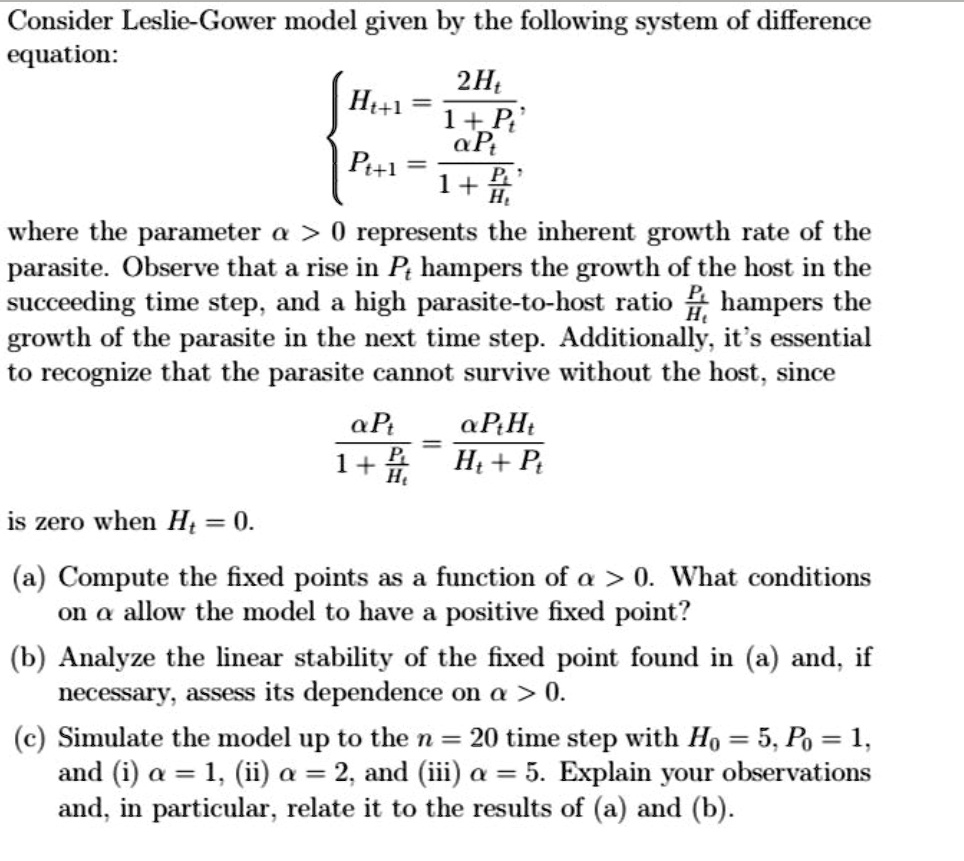
Consider Leslie-Gower model given by the following system of difference
equation:
\begin{cases}
H_{t+1} = \frac{2H_t}{1 + P_t} \\
P_{t+1} = \frac{\alpha P_t}{1 + \frac{P_t}{H_t}}
\end{cases}
where the parameter $\alpha > 0$ represents the inherent growth rate of the
parasite. Observe that a rise in $P_t$ hampers the growth of the host in the
succeeding time step, and a high parasite-to-host ratio $\frac{P_t}{H_t}$ hampers the
growth of the parasite in the next time step. Additionally, it's essential
to recognize that the parasite cannot survive without the host, since
$\frac{\alpha P_t}{1 + \frac{P_t}{H_t}} = \frac{\alpha P_t H_t}{H_t + P_t}$
is zero when $H_t = 0$.
(a) Compute the fixed points as a function of $\alpha > 0$. What conditions
on $\alpha$ allow the model to have a positive fixed point?
(b) Analyze the linear stability of the fixed point found in (a) and, if
necessary, assess its dependence on $\alpha > 0$.
(c) Simulate the model up to the $n = 20$ time step with $H_0 = 5$, $P_0 = 1$,
and (i) $\alpha = 1$, (ii) $\alpha = 2$, and (iii) $\alpha = 5$. Explain your observations
and, in particular, relate it to the results of (a) and (b).