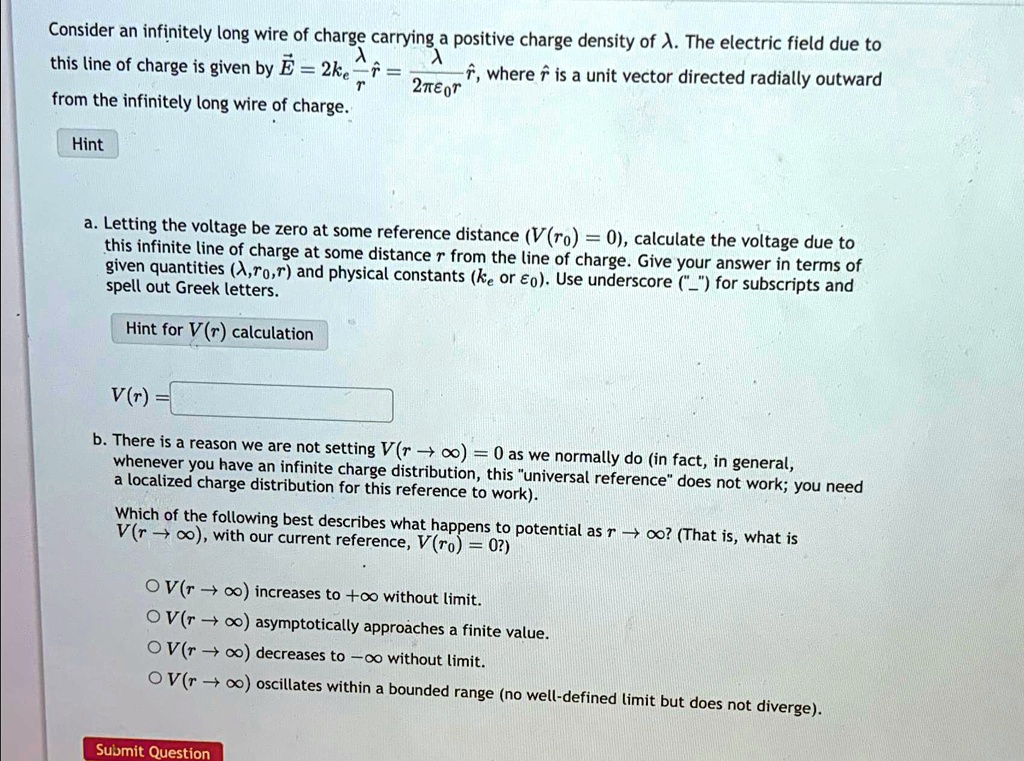
Consider an infinitely long wire of charge carrying a positive charge density of ?. The electric field due to
this line of charge is given by \(\vec{E} = 2k_e \frac{?}{r} \hat{r} = \frac{?}{2??_0 r} \hat{r}\), where \(\hat{r}\) is a unit vector directed radially outward
from the infinitely long wire of charge.
Hint
a. Letting the voltage be zero at some reference distance \((V(r_0) = 0)\), calculate the voltage due to
this infinite line of charge at some distance r from the line of charge. Give your answer in terms of
given quantities (?,r_0,r) and physical constants (k_e or ?_0). Use underscore ("_") for subscripts and
spell out Greek letters.
Hint for V(r) calculation
V(r) =
b. There is a reason we are not setting \(V(r \to \infty) = 0\) as we normally do (in fact, in general,
whenever you have an infinite charge distribution, this "universal reference" does not work; you need
a localized charge distribution for this reference to work).
Which of the following best describes what happens to potential as \(r \to \infty\)? (That is, what is
\(V(r \to \infty)\), with our current reference, \(V(r_0) = 0\)?
? \(V(r \to \infty)\) increases to \(+\infty\) without limit.
? \(V(r \to \infty)\) asymptotically approaches a finite value.
? \(V(r \to \infty)\) decreases to \(-\infty\) without limit.
? \(V(r \to \infty)\) oscillates within a bounded range (no well-defined limit but does not diverge).
Submit Question