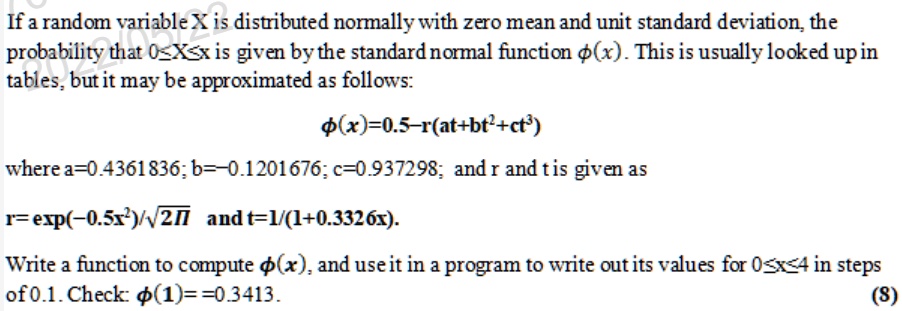
If a random variable X is distributed normally with zero mean and unit standard deviation, the probability that $0 \le X \le x$ is given by the standard normal function $\phi(x)$. This is usually looked up in tables, but it may be approximated as follows:
$\phi(x) = 0.5 - r(at + bt^2 + ct^3)$
where $a = 0.4361836$; $b = -0.1201676$; $c = 0.937298$; and $r$ and $t$ is given as
$r = \exp(-0.5x^2) / \sqrt{2\pi}$ and $t = 1/(1 + 0.3326x)$.
Write a function to compute $\phi(x)$, and use it in a program to write out its values for $0 \le x \le 4$ in steps of 0.1. Check: $\phi(1) = 0.3413$.